Internal fraud is when someone inside an organisation uses their trusted job to cheat it for money.
This guide is for students, new finance or office staff, and small business owners who want the basics in plain words. You do not need an accounting background: most internal fraud uses everyday tasks like expense claims, supplier payments and stock.
In short
- Internal fraud is done by staff, managers or contractors, using access the business gave them.
- Common types are fake or padded expense claims, fake supplier invoices, made-up staff on the payroll and stolen stock.
- It often grows where one person does a whole money task alone and nobody checks.
- Tips from colleagues are a major way it is found, so a safe way to speak up matters as much as audits.
What you will learn
- Explain what internal fraud is and how it differs from data theft.
- Spot the warning signs in expense claims and supplier payments.
- Explain the three conditions that make fraud more likely.
- Check whether one person in your team handles money tasks alone.
- Staff fraud (internal or occupational fraud)
- fraud by people who work for an organisation, against that organisation.
- Two people for money jobs (segregation of duties)
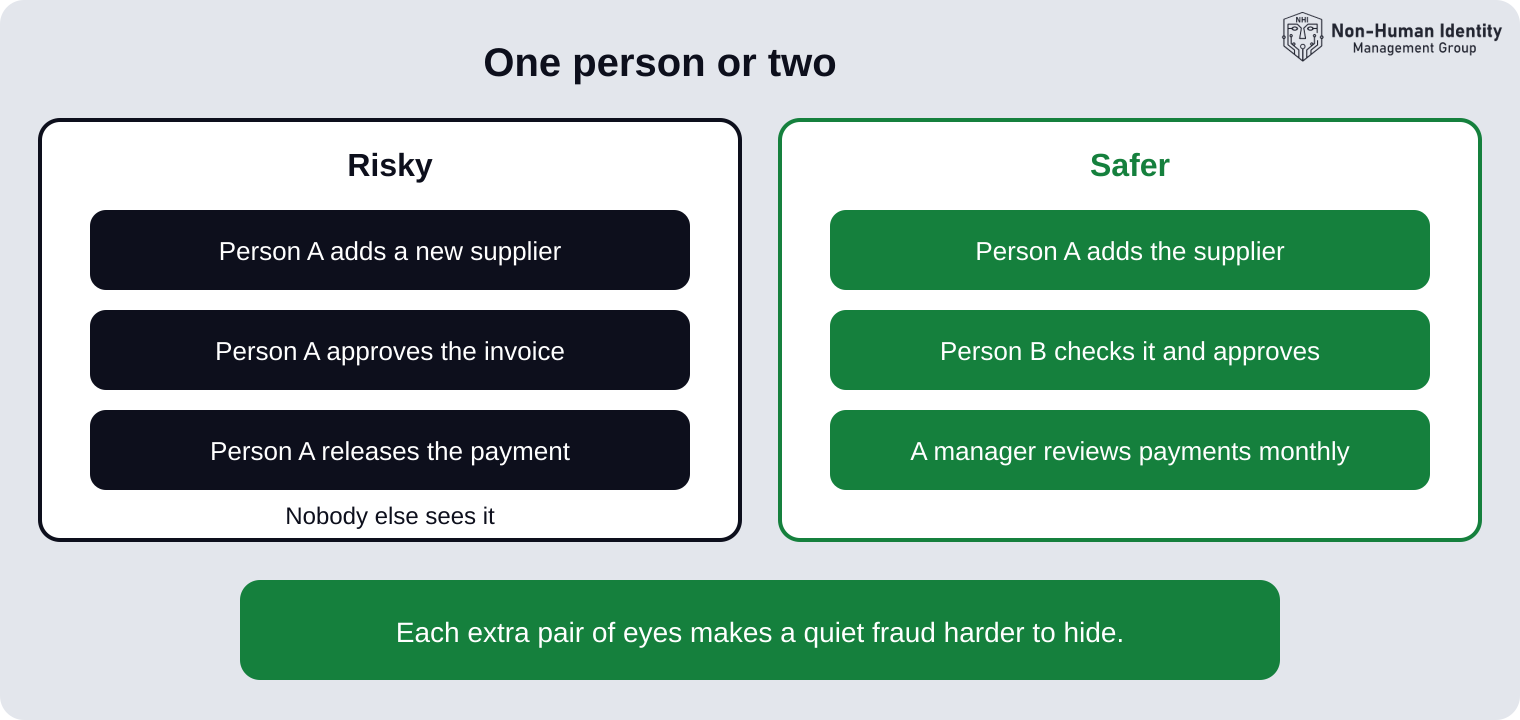
- splitting a money task so one person cannot start it, approve it and pay it.
- Why people cheat (the fraud triangle)
- a simple model: pressure, opportunity and an excuse.
What is internal fraud?
Think of a sports club treasurer who keeps the books and holds the chequebook. If nobody else ever looks at the books, a small "loan to myself" can go unnoticed for years.
Internal fraud works the same way. A person inside uses the trust and access their job gives them. They use it to take money or goods. Fraud experts call this occupational fraud. It means fraud by staff or bosses against their own employer.[2]
It usually falls into three groups. The first is taking or misusing the business's money or goods, like padded expenses. The second is corruption, like a secret payment from a supplier for a contract. The third is faking the accounts. It is the rarest type but often the costliest.[1]
This page is about money. An insider who copies customer data or damages systems is a different problem, covered in Insider Threats for Beginners.
Where the comparison stops working: a club treasurer handles one bank account. In a business, one person may reach payroll, suppliers and stock. So a fraud can be spread thinly across many places.
Why does it matter?
Internal fraud can run quietly for a long time, because the person knows how the checks work. A large global study by fraud examiners looked at this in 2024. A tip was how 43% of cases were first found. That was over three times more than the next method.[3]
If you run a small business
What could happen: one trusted bookkeeper pays a fake supplier every month, and nobody else reads the bank statement.
Check this: read the bank statement yourself each month and ask about any payee you do not know.
If you are new to a finance or office job
What could happen: a manager asks you to "just approve" a payment without the usual paperwork.
Check this: follow the written process every time, and ask a second person if you are unsure.
If you manage a team
What could happen: a team member who never takes leave is hiding something that only they can see.
Check this: make sure everyone takes real time off and someone else covers their tasks.
What does it look like?
Here is a made-up expense claim with some common warning signs. None of these signs proves fraud on its own. They are reasons to ask a polite question.
Example only. All values are made up.
EXPENSE CLAIM: Example Trading Ltd (FAKE)
Claimant: A. Example        Approver: A. Example   (1)
Sat 04 Oct  Client dinner        GBP 49.00         (2)
Sun 05 Oct  Taxi                 GBP 49.00         (2)
Mon 06 Oct  Client dinner        GBP 49.00         (3)
Receipts:   photo of 1 receipt, used for 2 lines   (4)
Supplier:   Example Services (new last week)       (5)
- The person claiming the money also approved it. A different person should approve.
- Round amounts just under a GBP 50 receipt limit, at a weekend.
- The same meal claimed again on a different day.
- One receipt photo used to support more than one line.
- A brand-new supplier being paid straight away.
Why this is risky: each line looks small, so nobody looks closely. Over a year, small claims like these can add up to a large sum, and the same habits can spread to supplier payments.
The safer way: claimants never approve their own claims. Each line needs its own receipt. A second person checks claims that sit just under a limit, and new suppliers are checked before the first payment.[4]
How does it work?
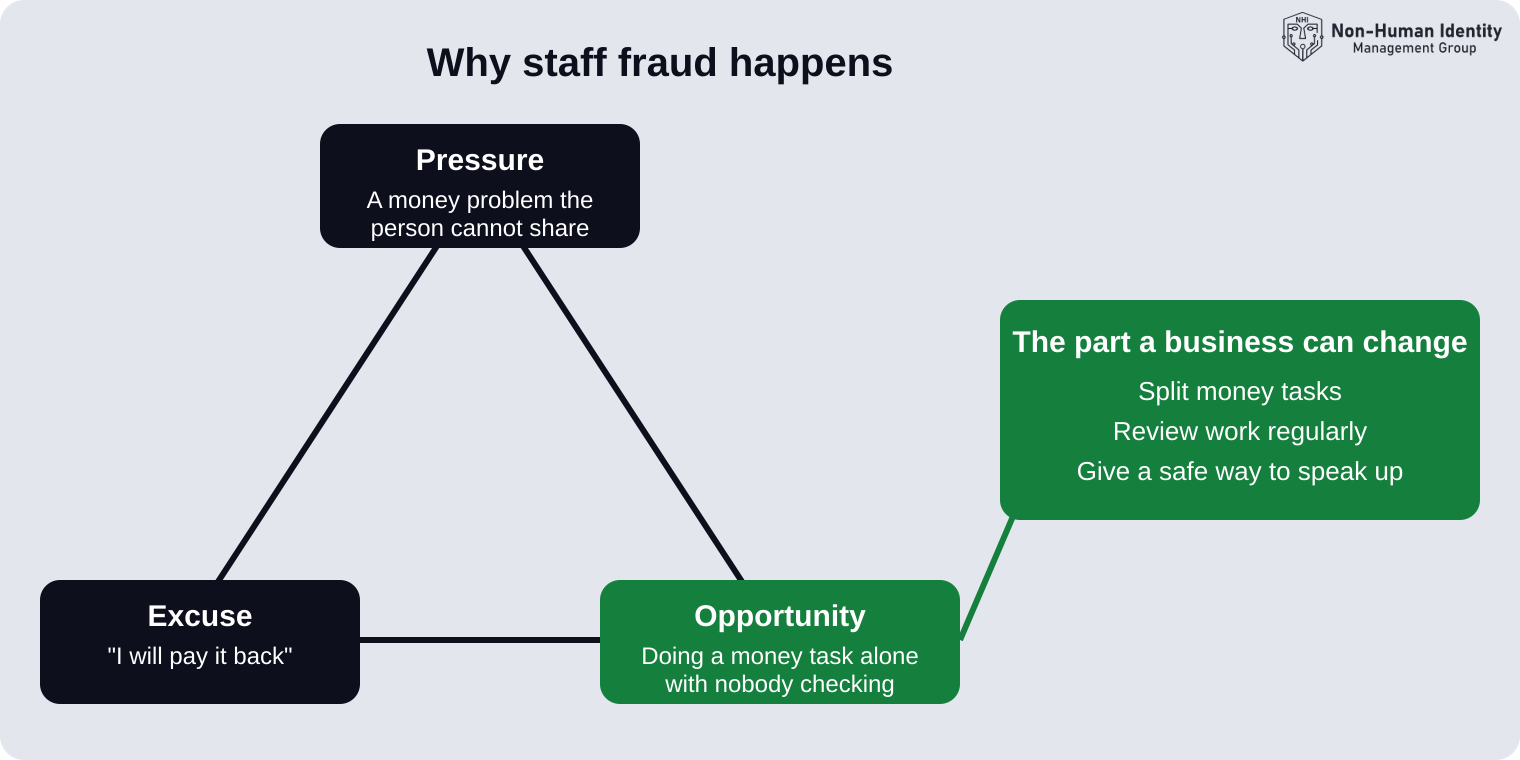
A criminologist called Donald Cressey studied people who stole from their employers. His idea, now called the fraud triangle, says fraud becomes much more likely when three things come together.[2]
- Pressure. The person feels a money problem they cannot share, such as debts or a target they cannot meet.
- Opportunity. They see a gap they can use, such as doing a whole money task alone with no check.
- An excuse. They tell themselves a story, such as "I am underpaid" or "I will pay it back".
- The scheme. They start small, often with expenses, fake invoices or stock, and grow if nobody notices.
- Discovery. A colleague's tip, a manager's review, a surprise check or data that looks odd brings it to light.
A business cannot see or control a person's private pressures or excuses. It can close the opportunity. In the same study, missing checks were a main weakness in 32% of cases. Someone getting round the checks was the weakness in another 19%.[3]
The most common schemes use ordinary business tasks.[4]
- Expenses: claims for meals or travel that were personal, padded or made up.
- Fake suppliers: invoices from a company the employee secretly controls, paid by the business.
- Payroll: pay for a made-up employee, or for someone who has left, sent to an account the fraudster controls.
- Procurement (buying): a buyer who takes a secret payment, called a kickback, from a supplier in return for contracts.
- Stock: goods taken from the warehouse or shop and written off as lost or damaged.
Computer access is part of this. In the finance system, give each person only the access their job needs. Remove it when they leave. This closes many of the gaps a fraud relies on.[4]
A worked example
Odile Pereira owns a small, fictional kitchen fitting company with twenty staff. Her office manager, Kemal Sorensen, has worked there for nine years. He handles supplier invoices, pays them through online banking and does the monthly accounts. Odile trusts him completely and rarely looks at the books.
Kemal's family is in debt, and he feels he cannot tell anyone. He sets up a small company called "KS Trade Supplies" and starts sending invoices for "sundries" to the business. He pays them himself. Each one is under a few hundred pounds, so it does not stand out.
Odile remembers the club treasurer who keeps the books and holds the chequebook. She realises that is exactly how her office works.
Things change after Odile reads a short guide on staff fraud. She decides to read the bank statement herself each month. In the third month she sees "KS Trade Supplies" again and again, and does not recognise the name. There is no order or delivery note for any of the payments.
She does not accuse anyone. She asks her accountant to look at the supplier records quietly. The accountant finds that the supplier's address matches Kemal's home address. Odile takes advice from a solicitor and her accountant before speaking to Kemal, and keeps the records safe.
Afterwards she changes the process. A second person now adds any new supplier. Odile approves payments in the banking app. Staff can raise concerns in confidence with her accountant. She also makes sure every person takes two weeks of leave each year, with someone else covering their work.
Myths and mistakes
| What people think | What is true |
|---|---|
| Our long-serving staff would never do this. | The study found that losses tend to be larger the longer the fraudster has worked there, because trust and knowledge grow.[3] |
| Our yearly audit will catch it. | Tips are a much more common way fraud is first found than outside audits.[3] Regular checks inside the business matter too. |
| Small claims are not worth checking. | Many schemes start small and grow. Simple spot checks on small claims are cheap. |
| Splitting tasks means we do not trust people. | Splitting tasks protects honest staff too, because it shows clearly that they did nothing wrong. |
| If I suspect fraud, I should confront the person. | Report it to a manager, owner or the business's speak-up contact, and keep any records safe. Investigating is a job for them. |
What can I do this week?
- List every money task (adding suppliers, approving invoices, paying, payroll changes) and who does each one.
- Find any task where one person does every step alone, and add a second person.
- Read last month's bank statement and ask about any payee you do not recognise.
- Tell staff how to raise a concern in confidence, and who will listen.
- Check that people who have left no longer have access to the finance system.
Checklist
- No one approves their own expense claim.
- Adding a supplier and paying it are done by different people.
- Someone other than the payer reads the bank statement each month.
- Expense claims need one receipt per line.
- New suppliers are checked before the first payment.
- Staff in money roles take regular leave, with someone else covering.
- There is a confidential way to report concerns.
- Finance system access matches each person's job and is removed when they leave.
Common questions
What is the difference between internal fraud and an insider threat?
Internal fraud is about money: an insider cheats the business for gain. "Insider threat" is wider. It also covers people who copy data, damage systems or make careless slips. Internal fraud is one kind of insider threat. It is about payments, expenses, suppliers and stock.
What is the fraud triangle?
It is a simple model of why people commit fraud. It says fraud is much more likely when a person feels financial pressure, sees an opportunity and can find an excuse. A business has most control over the opportunity, by splitting tasks and checking work.
How is internal fraud usually found?
Most often through a tip from someone who noticed something odd. In the 2024 global study, tips were behind 43% of first detections.[3] Manager reviews, audits, surprise checks and data checks find many of the rest. That is why a safe way to speak up matters.
Do warning signs mean someone is guilty?
No. A round number, a weekend claim or a person who skips leave can all have honest reasons. Warning signs are prompts to ask a polite question or look at the records. Treat people fairly and let the right people investigate.
What should I do if I suspect a colleague?
Write down what you saw and when, and report it through your organisation's speak-up route or to a manager you trust. Do not confront the person or gather evidence yourself. That can warn them or harm a fair investigation.
Where next?
Ready for the detail? Read the practitioner guide: Occupational and Internal Fraud Guide. It goes further into the full fraud tree, controls for each scheme type, running a reporting hotline and data tests that find fraud early.
Also useful:
- Segregation of Duties for Beginners
- Insider Threats for Beginners
- Payment Fraud for Beginners
- Cyber Whistleblowing Guide
Related NHI Mgmt Group resources: Segregation of Duties Guide · Insider Risk vs Insider Threat · Accounting Software Security for Beginners
Key terms
- Occupational fraud
- Fraud by an employee, manager or executive against the organisation they work for.
- Fraud triangle
- A model saying fraud is more likely when pressure, opportunity and an excuse come together.
- Segregation of duties
- Splitting a task between people so no one person can complete a risky job alone.
- Least privilege
- Giving each person only the access their job needs.
- Kickback
- A secret payment from a supplier to a buyer in return for business.
- Asset misappropriation
- Stealing or misusing an organisation's money, goods or equipment.
Sources and further reading
- The Fraud Tree explained. ACFE Insights blog, Association of Certified Fraud Examiners (ACFE), 2026. https://www.acfe.com/acfe-insights-blog/blog-detail?s=fraud-tree-explained, accessed 28 Nov 2026.
- Fraud 101: What is fraud? Association of Certified Fraud Examiners (ACFE). https://www.acfe.com/fraud-resources/fraud-101-what-is-fraud, accessed 28 Nov 2026.
- Occupational Fraud 2024: A Report to the Nations. Association of Certified Fraud Examiners (ACFE), 2024. https://legacy.acfe.com/report-to-the-nations/2024/, accessed 28 Nov 2026.
- Occupational and Internal Fraud Guide. NHI Mgmt Group. https://nhimg.org/occupational-fraud-and-internal-fraud-guide, accessed 28 Nov 2026.