A security champion is a team member who helps their own team build software safely.
This guide is for developers, testers, students and managers who have heard the term and want to know what the role involves. You do not need to be a security expert to become one: most champions start as developers or testers who are curious about security.
In short
- A security champion is a developer, tester or operations person who acts as the security contact for their own team.
- They do not replace the security team. They link the team to it and spot problems early.
- The role works best when managers give champions set time, training and thanks.
- Champions usually help with things like reviewing risky changes, planning for threats and running team learning sessions.
What you will learn
- Explain what a security champion does in one sentence.
- Spot the signs that a team would benefit from a champion.
- Check whether a champion role has the time and support it needs.
- Ask the right questions before you volunteer for the role.
- Team security contact (security champion)
- a team member who is the first person to ask about security in their team.
- Central experts (security team)
- the specialist staff who set security rules and help many teams at once.
- Checking a change (code review)
- a teammate reading new code before it is added, to catch mistakes.
What is a security champion?
Think of the trained first-aider in an office. They are not a doctor. They know enough to help straight away, and they know when to call for an expert.
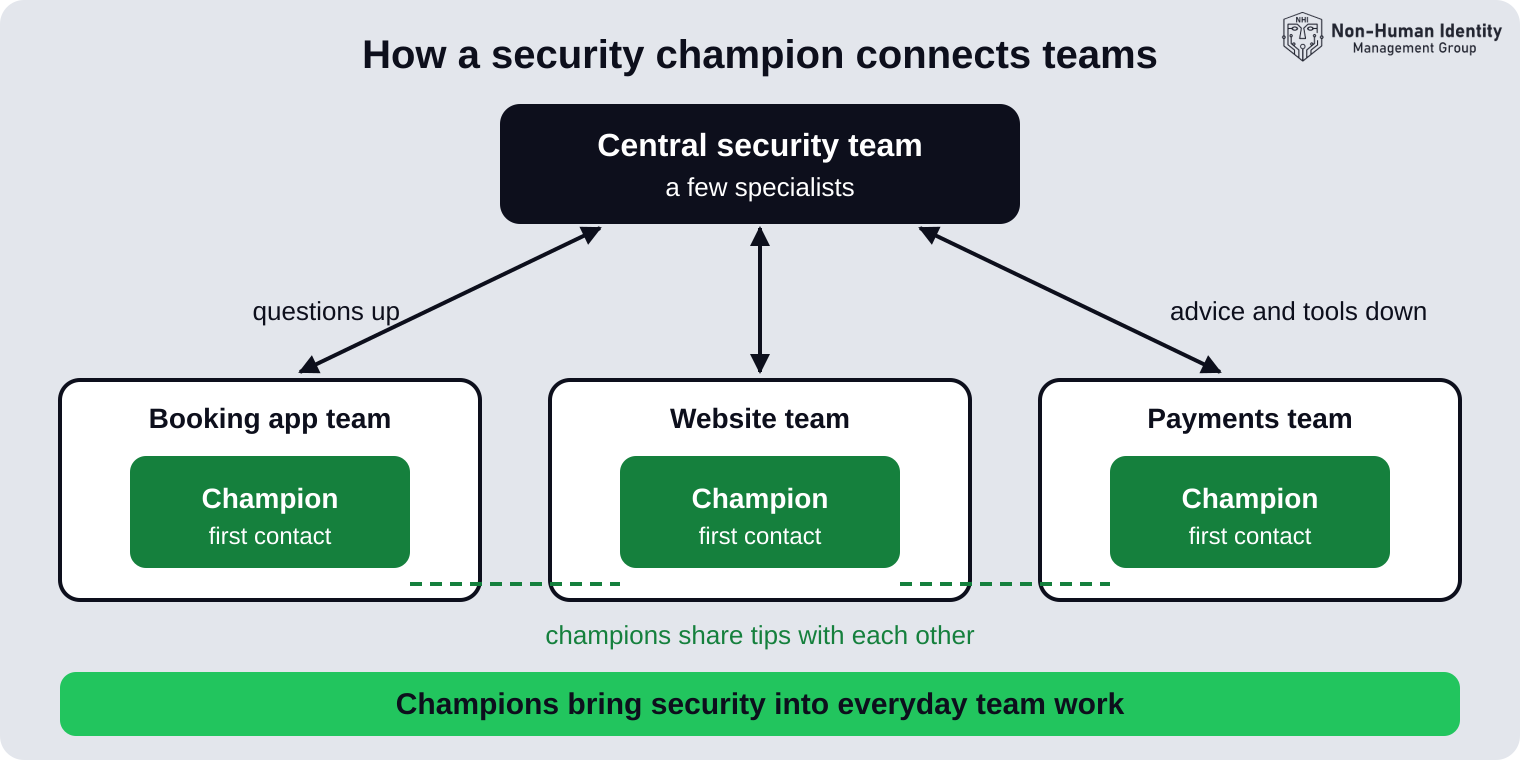
A security champion plays that part for security in a software team. They are usually a developer, tester or operations person who stays in their normal job. On top of it, they become the team's first contact for security questions.[1] When something looks risky, they help the team think it through, and they bring in the central security team when it needs an expert.
Why is this needed? A company may have a few security specialists and dozens of software teams. The specialists cannot sit in every meeting. A champion inside each team helps spread good habits much further.[1]
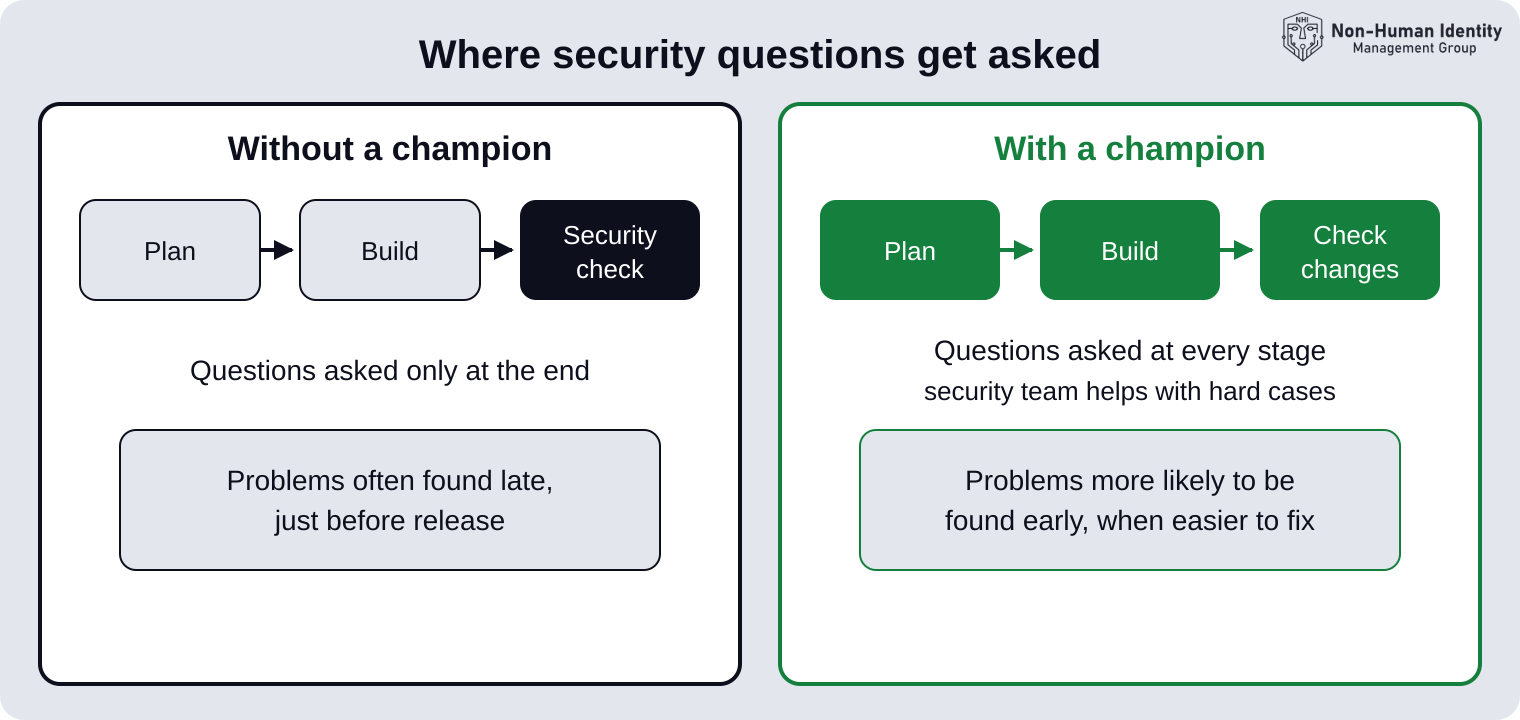
Where the comparison stops working: a first-aider mostly waits for an accident. A good champion spends most of their effort before anything goes wrong, by asking safety questions while the software is still being planned and built.
Why does it matter?
Security problems are often easier to fix when they are caught early, before release. A champion helps the team catch them at that stage, in a way that fits how the team already works. The UK's National Cyber Security Centre puts it simply: every team needs security know-how, but not everyone needs to be an expert.[4]
If you are a developer or tester
What could happen: nobody on the team feels it is their job to ask "could this be misused?", so a risky change goes out unchecked.
Check this: who on your team would you ask about a security worry today?
If you manage a software team
What could happen: a keen volunteer takes on the role with no time set aside, gets worn out and quietly stops.
Check this: is champion work counted in their workload and their review?
If you are a student or new to tech
What could happen: you miss an easy way to learn security skills on the job, without changing career.
Check this: ask in interviews whether the company has a champions group.
What does it look like?
Here is a made-up role card that a company might write when it asks for champions.
Example only. All values are made up.
Role card: Security champion (EXAMPLE Ltd)
Team: Booking app team
Time: about 1 day in 5 for security work   (1)
Reports security questions to: FAKE-Security-Contact  (2)
Main tasks:
 - first contact for the team's security questions
 - joins planning to ask "how could this be misused?"  (3)
 - checks risky changes, such as login or payment code
 - shares one security tip at the team meeting
Support: training, monthly champions meet-up  (4)
- Set time for the role, agreed with the manager. One OWASP guide gives 20% as an example.[1]
- A named person in the security team the champion can always go to.
- Thinking about misuse early is called threat modelling.
- Training and a group of other champions to learn from.
Why this is risky: a role card with no set time, no named contact and no training is a title, not a role. Champions in that position tend to drift away.
The safer way: agree the time, the contact and the support before anyone starts. OWASP guidance says champions need a set share of their time, backed by their manager. It also says each champion should keep in touch with someone in the security team.[1]
How does it work?
Most champion programmes follow a similar path. OWASP's playbook sets out these broad steps.[2]
- Pick the teams. Decide which teams will take part first.
- Write down the role. Agree what a champion does, and how much time they get.
- Find the champions. Managers suggest people, or people put their own names forward. Interest matters more than expert knowledge.[1]
- Connect them. Set up a shared chat channel and regular meet-ups with the security team.
- Build their knowledge. Give training and a place to find answers.
- Keep them going. Thank and reward champions, and plan for people moving on.[3]
A champion's week might include reading a risky change before it is added. It might also mean asking misuse questions at planning, or helping a teammate use a testing tool.[1] When a problem is bigger than they can handle, they pass it to the security team.
A worked example
Kaia Vance is a developer at Fern Vets, a chain of animal clinics. Her team builds the app that pet owners use to book appointments. Fern Vets has two security staff and six software teams, so the security staff rarely join her team's meetings.
The company asks for volunteers to become security champions. Kaia is curious, so she talks to her manager first. They agree she will spend about one day a week on champion work. Dario Thorne from the security team becomes her named contact.
In her first month, Kaia goes to a short training course and joins a chat channel with the other five champions. At her team's planning meeting, she asks one new question about each feature: "How could someone misuse this?"
The team is about to add a feature that lets owners download their pet's records. Kaia asks whether one owner could change a number in the web address and see someone else's records. Nobody is sure. She asks Dario, who explains how to check that the app only shows records to their owner. The team adds that check and a test for it before release.
Later, a teammate pastes a password into the team chat. Kaia reminds them, kindly, that the password should be changed and stored in the company's password vault. She does not report anyone. She treats it as a chance to learn.
After three months, Kaia shares what she has learned with the other champions. Her manager mentions her champion work in her review. The team now asks security questions on its own, without waiting for Kaia to raise them.
Myths and mistakes
| What people think | What is true |
|---|---|
| A champion has to be a security expert. | Champions are usually developers, testers or operations staff who are interested in security. Training comes with the role. |
| Once we have champions, we do not need a security team. | Champions extend the security team's reach. They still need experts to go to for the hard cases. |
| The champion is responsible for all of the team's security. | Security is a team effort. The champion helps the team, but everyone owns the code they write. |
| Anyone can do it in their spare time. | Without set time and management backing, champions tend to burn out or drop away. |
| A champion's job is to catch and report mistakes. | A champion helps people learn. A blame culture tends to make people hide problems.[4] |
What can I do this week?
- Ask your team who people go to with security questions now.
- Find out whether your company already has a champions group or chat channel.
- Read your company's security rules for developers, if it has them, and note one thing you did not know.
- Ask "how could this be misused?" about one feature your team is building.
- If you manage a team, ask the security team what support a champion would get.
Checklist
- The champion role is written down, with its main tasks.
- The champion has set time for the role, agreed with their manager.
- Each champion has a named contact in the security team.
- Champions get training when they start, and ongoing learning.
- There is a shared channel and a regular meet-up for champions.
- Champion work is recognised, for example in reviews or newsletters.
- There is a plan for when a champion moves team or leaves.
- The team treats security mistakes as chances to learn, not to blame.
Common questions
Is a security champion a full-time job?
Usually not. Most champions keep their main job as a developer, tester or operations person and spend part of their time on security. One OWASP guide gives 20% of their time as an example.[1] The share should be agreed with their manager, so the work is planned rather than squeezed in.
Do I need security qualifications to become a champion?
No. Interest and a willingness to learn matter most. Programmes normally give champions training once they start. You know your own team's code and habits. That inside view is a big part of what makes you useful.
What is the difference between a champion and the security team?
The security team are full-time specialists who set rules and help many teams. A champion sits inside one team and is its first contact for security. The champion brings everyday questions to the security team and takes their advice and tools back to the team.
Is being a champion good for my career?
It can be. You learn security skills while keeping your current job, and you work with specialists you might not meet otherwise. Some champions later move into security roles. Treat that as a possible benefit, not a promise, and ask how your company recognises the work.
What if my team ignores my security advice?
Raise it calmly with your named security contact or your manager. A champion advises; decisions about risk usually sit with the team lead or product owner. Explaining the risk in plain words, with a likely example, often works better than quoting rules.
Where next?
Ready for the detail? Read the practitioner guide: Security Champions Programme Guide. It goes further into programme design, how to measure whether it is working and how to scale it across many teams.
Also useful:
- Security Champions vs Centralised AppSec
- Threat Modelling for Beginners
- Secure Code Review for Beginners
- DevSecOps for Beginners
- Application Security for Beginners
Related NHI Mgmt Group resources: Secure Software Development Lifecycle (SSDLC) Guide · AppSec Programme Metrics Guide · Top 10 AppSec Programme Mistakes
Key terms
- Security champion
- A team member who acts as their team's first contact for security and helps it build safely.
- Security champions programme
- A company's plan for choosing, training and supporting champions across its teams.
- Threat modelling
- Thinking through how a system could be attacked or misused, so the team can plan defences early.
- Code review
- A person reading a proposed code change before it is added, to catch mistakes and risks.
- Secure coding
- Writing software in ways that make security flaws less likely.
- DevSecOps
- A way of working that builds security checks into everyday software building and release.
Sources and further reading
- OWASP Security Culture, Security Champions chapter. OWASP Foundation. https://owasp.org/www-project-security-culture/stable/4-Security_Champions/, accessed 28 Nov 2026.
- Security Champions Playbook. OWASP Developer Guide, OWASP Foundation. https://devguide.owasp.org/08-culture-process/02-security-champions/03-security-champions-playbook, accessed 28 Nov 2026.
- OWASP Security Champions Guide (ten principles, incubator project). OWASP Foundation. https://securitychampions.owasp.org/, accessed 28 Nov 2026.
- Secure development is everyone's concern. Secure development and deployment guidance, National Cyber Security Centre (UK). https://www.ncsc.gov.uk/collection/developers-collection/principles/secure-development-is-everyones-concern, accessed 28 Nov 2026.