A security product certification is an official record that a lab tested a product's security claims.
This guide is for buyers, public sector IT staff and anyone who sees "certified" on a product sheet. You do not need to be technical. If you help choose firewalls, smart cards, laptops or software for work, the badge can decide which products are allowed on the list.
In short
- A product certificate says a lab checked a set of security claims for one product, in one version and setup.
- Common Criteria is the best-known international scheme. EUCC is the EU scheme built on it. FIPS 140-3 covers the parts of a product that scramble data.
- The certificate is only as useful as its scope. Read what was tested, which version, and when it ends.
- A certificate does not mean a product has no flaws. Updates and new flaws still need watching.
What you will learn
- Explain what a product certification proves in one sentence.
- Tell a product certificate apart from a company or person certificate.
- Check a certificate's scope, version and expiry date.
- Ask a supplier the right questions before you rely on a badge.
Status: correct as at 28 November 2026, based on the official scheme pages (Common Criteria, ENISA, EUR-Lex and NIST). Schemes change; check the official text.
This guide explains the topic in general terms and is not legal advice.
- What was tested (target of evaluation)
- the exact product, version and setup the lab checked.
- The claims sheet (security target)
- the document that lists the security features the maker claims and the lab checked.
- Product badge (certification)
- an official record that the checks were passed, issued by a recognised body.
What is a security product certification?
Think of a crash test rating for a new car. Testers crash one model, set up a certain way, and publish what they found. You do not crash the car yourself.
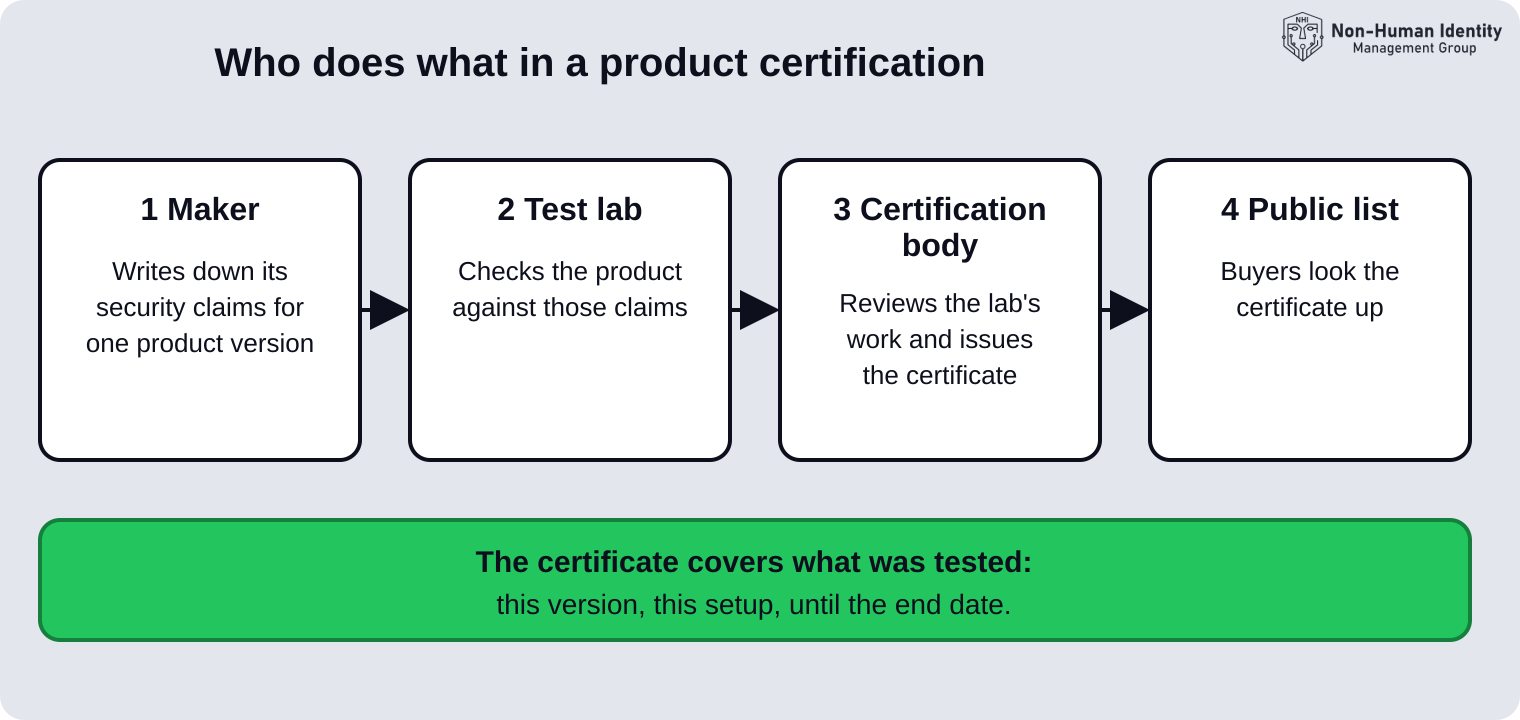
A security product certification works the same way. The maker writes down the security features it claims. An approved test lab checks those claims. A certification body (an official group that oversees the labs) reviews the work and issues a certificate if the checks are passed.
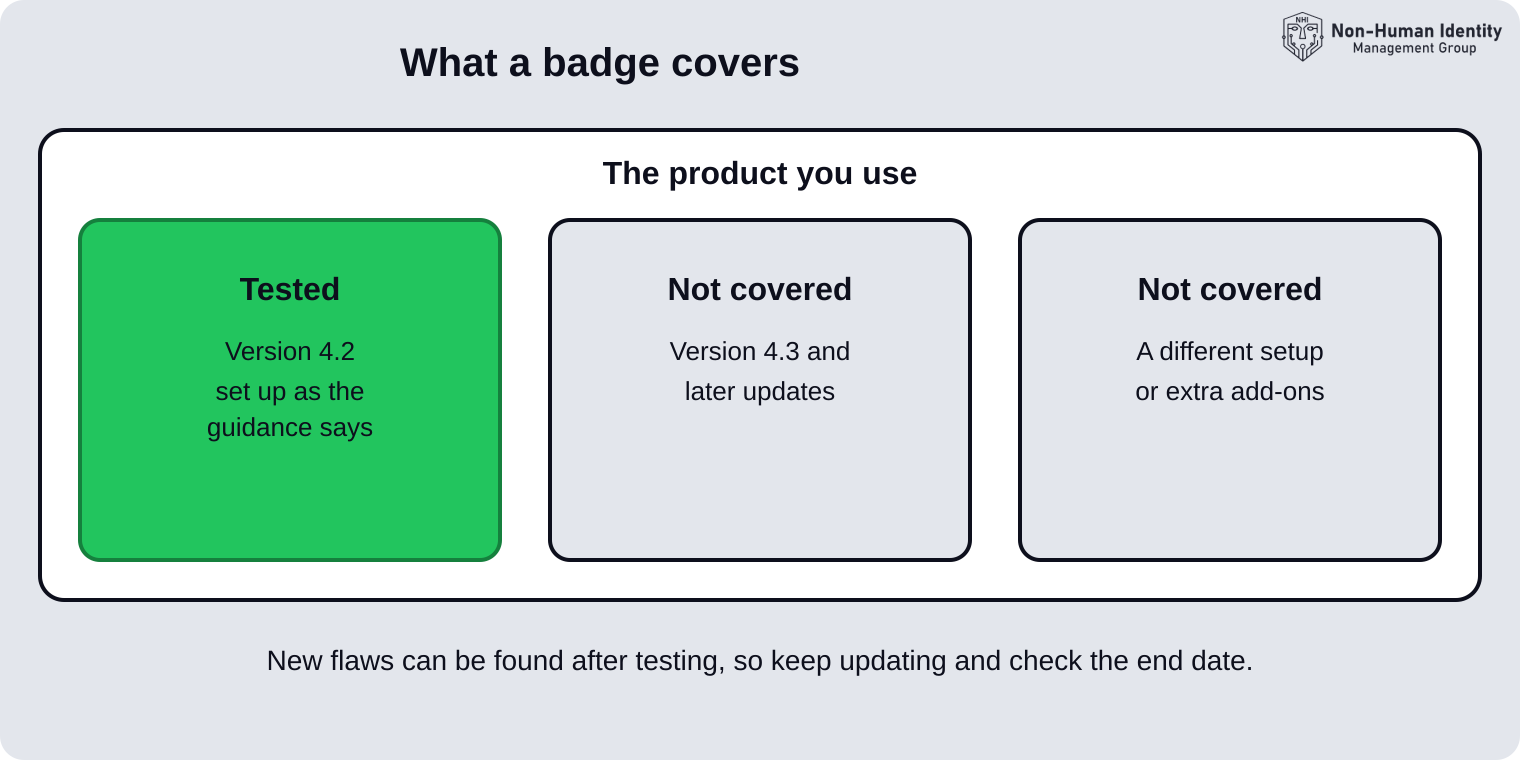
The certificate covers what was tested. That is one product, in one version, often in one setup. It is not a promise about every version, or every way the product can be used.
This is different from two other kinds of certificate. A company certificate checks how a business runs its security. A person's certificate shows what an individual has learned. This page is about products.
Where the comparison stops working: a car's crash rating stays roughly true for that model. A software product changes with updates, and new flaws can be found after testing. A certificate can age faster than a crash rating.
Why does it matter?
Some buyers, especially governments, may only accept certified products for certain jobs. A badge saves each buyer from testing everything alone. But it only helps if people read what it covers.
If you buy IT for the public sector
What could happen: you buy the right product name but the wrong version, and it is not the one that was tested.
Check this: match the version and setup on the certificate to what the supplier will deliver.
If you run a small IT team
What could happen: you treat "certified" as "safe" and skip updates or a sensible setup.
Check this: keep the product updated and set up as the maker's guidance says.
If you are new to security work
What could happen: you mix up a product badge with a company or course certificate in a report.
Check this: ask "who or what was checked?" A product, a company or a person.
What does it look like?
Here is a made-up summary of a product certificate. Real ones are longer, but they hold the same kinds of detail.
Example only. All values are made up.
EXAMPLE product certificate (fake)
Product:     ExampleGate Firewall              (1)
Version:     4.2.0 only                        (2)
Setup:       as in guidance document EX-0000   (3)
Claims:      security target EX-ST-0000
Level:       "substantial" (example)           (4)
Issued:      01 Jan 2025   Ends: 31 Dec 2029   (5)
Lab:         Example Test Lab (example.invalid)
- In a real file, this line would contain the exact product name.
- Only this version was tested. A newer version may not be covered.
- The product was tested set up in a certain way. A different setup may not match.
- How hard the lab looked. A higher level means deeper testing of the same claims.
- Certificates end. In the EU scheme, five years is the usual maximum.
Why this is risky: people often read only the product name and the word "certified". They miss the version, the setup and the end date, which decide whether the badge applies to what they bought.
The safer way: look the certificate up in the scheme's own public list, not just the supplier's leaflet. Then check that the version, setup and dates match what you will use.
How does it work?
Most product schemes follow similar steps.
- The maker writes its claims. It lists the security features of the product in a claims document. This is called the security target.[2]
- A lab tests the claims. An approved independent lab checks the product against those claims, at the level of depth chosen.[3]
- A certification body reviews. An official body checks the lab's work and issues the certificate.
- The certificate is published. It goes on a public list, so buyers can look it up.[4]
- The maker keeps watching. In the EU scheme, the holder must handle new flaws and tell the certification body when one is confirmed.[4]
You will meet three names most often.
- Common Criteria. An international set of rules for testing IT product security. Under an agreement between many countries, certificates from approved national schemes are recognised by all the countries that signed it.[1]
- EUCC. A voluntary EU scheme for chips, hardware and software, based on Common Criteria.[3] It has two levels, called "substantial" and "high", and certificates usually last up to five years.[4]
- FIPS 140-3. A US and Canadian programme that checks the part of a product that scrambles data, called a cryptographic module. Independent accredited labs do the testing.[5] It does not check the whole product.
A worked example
Idris Lomax buys IT equipment for a fictional county council. The council needs new smart card readers for staff to sign in to their laptops. The buying rules say the readers must hold a recognised product certificate.
Hana Castell, a sales manager at a supplier, sends a leaflet. It says "Certified" in large letters, with a badge in the corner.
Idris remembers the crash test rating: it applies to the model that was tested. So he asks Hana for the certificate number and looks it up on the scheme's public list.
The certificate is real. But it covers version 2 of the reader software, and Hana's quote is for version 3. The certificate also ends next spring.
Idris writes back with three questions. Is version 3 being tested? Is there a plan to renew the certificate? How will the maker tell customers about new flaws?
Hana checks with the maker. Version 3 is in testing, with results expected in a few months. The maker offers to supply version 2 until then, with security updates.
Idris records the decision and the dates in the contract file. He also sets a reminder to check the list again when version 3 is due. The badge helped, but only because he read what it covered.
Myths and mistakes
| What people think | What is true |
|---|---|
| Certified means the product has no security flaws. | It means a lab checked a set of claims. New flaws can still be found, which is why the EU scheme asks holders to handle them.[4] |
| The certificate covers every version. | It covers the version and setup that were tested.[2] Check the version you will use. |
| A higher level means more security features. | The level is about how deeply the claims were checked. What was claimed is in the claims document. |
| A badge on a leaflet is enough. | Look the certificate up on the scheme's public list and check the dates. |
| A FIPS 140-3 badge covers the whole product. | It covers the module that scrambles data, not the whole product.[5] |
What can I do this week?
- Pick one security product your organisation relies on and find out whether it holds a product certificate.
- Look the certificate up on the scheme's public list.
- Compare the tested version and setup with what you run.
- Note the end date in your contract or asset records.
- Ask the supplier how they tell customers about new flaws.
Checklist
- We know which scheme the certificate comes from.
- We found the certificate on the scheme's own public list.
- The tested version matches the version we use or will buy.
- We set the product up as the tested guidance describes.
- We know the certificate's end date and have a reminder.
- The supplier has a clear way to report new flaws and send updates.
- We do not treat the badge as a reason to skip updates or our own checks.
Common questions
What is the difference between Common Criteria and EUCC?
Common Criteria is the international set of testing rules. EUCC is an EU scheme that uses those rules, with EU-wide requirements on top. These include two named levels, a usual maximum of five years and duties to handle new flaws. A product can hold one, the other or both.
Is a product certificate the same as a company certificate?
No. A company certificate checks how a business runs its security as an ongoing system. A product certificate checks one product's security claims. A supplier may hold both, but one does not stand in for the other. Ask which one your buying rules need.
Does a certified product still need updates?
Yes. New flaws can be found after testing, and updates fix them. An update may change the version. Ask whether the maker plans to certify the new version, and how it handles flaws in the meantime.
Where can I check whether a certificate is real?
Use the scheme's own public list, not the supplier's leaflet. The Common Criteria portal has a certified products section, and the FIPS programme has a public search.[1][5] Search by product or maker, then check the version and dates.
Does every product need a certificate?
No. Most schemes are voluntary, and many good products have none. Certificates matter most where buying rules, regulators or high-risk uses call for them. For other buys, a supplier's update record and your own checks may tell you more.
Where next?
Ready for the detail? Read the practitioner guide: Common Criteria Evaluation Guide. It goes further into reading a security target, what the assurance levels test and how international recognition works.
Also useful:
- EU Cybersecurity Certification EUCC Guide
- FIPS 140-3 and Cryptographic Module Validation Guide
- Buying Security Products for Beginners
- EU Cyber Resilience Act for Beginners
Related NHI Mgmt Group resources: FIPS 140-2 vs FIPS 140-3 · Security Certifications for Businesses for Beginners · Cyber Security Frameworks for Beginners
Key terms
- Certification
- An official record that a product, company or person passed a set of checks.
- Common Criteria
- An international set of rules for testing the security claims of IT products.
- Security target
- The document listing the security claims for one product that the lab checks.
- Protection profile
- A shared list of security needs for a type of product, such as firewalls, that makers can test against.
- Target of evaluation
- The exact product, version and setup that was tested.
- FIPS 140-3 validation
- A US and Canadian check of the part of a product that scrambles data.
Sources and further reading
- Common Criteria Portal (home page: Common Criteria and the Common Criteria Recognition Arrangement). Common Criteria Recognition Arrangement. https://www.commoncriteriaportal.org/index.cfm, accessed 28 Nov 2026.
- Common Criteria for Information Technology Security Evaluation, CC:2022 Revision 1, Part 1: Introduction and general model. Common Criteria, November 2022. https://www.commoncriteriaportal.org/files/ccfiles/CC2022PART1R1.pdf, accessed 28 Nov 2026.
- EUCC certification scheme. ENISA, European Union Agency for Cybersecurity. https://certification.enisa.europa.eu/certification-library/eucc-certification-scheme_en, accessed 28 Nov 2026.
- Commission Implementing Regulation (EU) 2024/482 of 31 January 2024 on the European Common Criteria-based cybersecurity certification scheme (EUCC). EUR-Lex, European Union. https://eur-lex.europa.eu/legal-content/EN/TXT/HTML/?uri=CELEX:32024R0482, accessed 28 Nov 2026.
- Cryptographic Module Validation Program. NIST Computer Security Resource Center. https://csrc.nist.gov/projects/cryptographic-module-validation-program, accessed 28 Nov 2026.