The Data (Use and Access) Act 2025 is a UK law that updated the country's privacy rules.
This guide is for anyone in the UK who uses apps and websites, runs a small business or charity, or is new to privacy work. If your organisation holds customer or staff details, some of these changes already apply to you.
In short
- The Act did not replace the UK GDPR. It changed parts of it, along with the UK's data protection and email marketing rules.
- It became law on 19 June 2025, and the data protection changes were in force by 19 June 2026.
- Key changes cover complaints, requests to see your data, some cookies, automated decisions and charity marketing.
- The UK regulator is now called the Information Commission, after the change on 30 September 2026.
What you will learn
- Explain what the Act is and how it relates to the UK GDPR.
- Spot the changes most likely to affect you or your organisation.
- Check whether your complaints process and cookie banner need a review.
- Ask the right questions of the people who handle your data.
Status: correct as at 28 November 2026, based on the Act on legislation.gov.uk, the UK government's commencement page and the regulator's guidance. Laws change; check the official text.
This guide explains the topic in general terms and is not legal advice.
- Information about a person (personal data)
- anything that can identify someone, such as a name, an email address or a customer number.
- The UK's main privacy law (UK GDPR)
- the rules on how organisations in the UK collect, use and protect personal data.
- Coming into force (commencement)
- the date a part of a new law actually starts to apply.
What is the Data (Use and Access) Act?
Think of the rules of the road. Most of the rules stay the same for years, but now and then the government updates a few of them. Drivers do not relearn how to drive. They learn what changed.
The Data (Use and Access) Act 2025 is that kind of update for UK privacy law. The UK GDPR is still the main set of rules. The Act changed parts of it and of other related laws.[3]
Some changes make life easier for organisations. For example, some uses of data for public safety no longer need a careful balancing test. Other changes give people new protections, such as a clear right to complain to the organisation itself.[1]
The Act also covers topics beyond privacy. These include trusted digital identity services and data sharing schemes, sometimes called smart data.[2]
Where the comparison stops working: road rule changes usually start on one day. This Act came into force in stages, over about a year, so the date matters when you read older advice.
Why does it matter?
Advice written before mid-2026 may now be out of date. Firms that hold data about people may need to change a few ways of working. People who use UK services gain some new rights.
If you use apps and websites
What could happen: you complain about how your data was used, and nobody replies.
Check this: organisations must now acknowledge a data protection complaint within 30 days.
If you run a small business
What could happen: your cookie banner, complaints process or privacy notice no longer matches the rules.
Check this: review your complaints route and cookie settings against current regulator guidance.
Next: UK GDPR for Beginners
If you help run a charity
What could happen: you miss a new, simpler route for emailing your supporters.
Check this: ask whether the new charity "soft opt-in" fits your supporter emails, and keep an easy way to say no.
If you are new to privacy work
What could happen: you learn the rules from an older course and give out-of-date advice.
Check this: look for the date on any guidance, and prefer pages updated after June 2026.
What does it look like?
Here is a made-up "Am I affected?" checklist that a small UK firm might fill in.
Example only. All values are made up.
Firm: EXAMPLE Ltd (website: example.com)
Do people complain to us about their data?       YES  (1)
Do we get requests to see personal data?         YES  (2)
Does our website set analytics cookies?          YES  (3)
Do we make decisions about people by software?   NO   (4)
Do we use the name "ICO" in our documents?       YES  (5)
Checked by: FAKE-0000   Date: 0000-00-00
- People need an easy way to complain, such as an online form. Each complaint needs a reply within 30 days to say it arrived.
- Searches for a person's data must be reasonable and in proportion.
- Some cookies, such as ones that count visits, can now be set without asking first. Conditions apply.
- Big decisions made only by software have more legal routes now. They still need safeguards.
- The regulator's name changed in September 2026. In a real file, this line would list the documents to update.
Why this is risky: a firm that does not check may keep an old way to complain. It may also name the wrong regulator.
The safer way: go through each "yes" with the regulator's current guidance. Note what changed. Write down the date of the check.
How does it work?
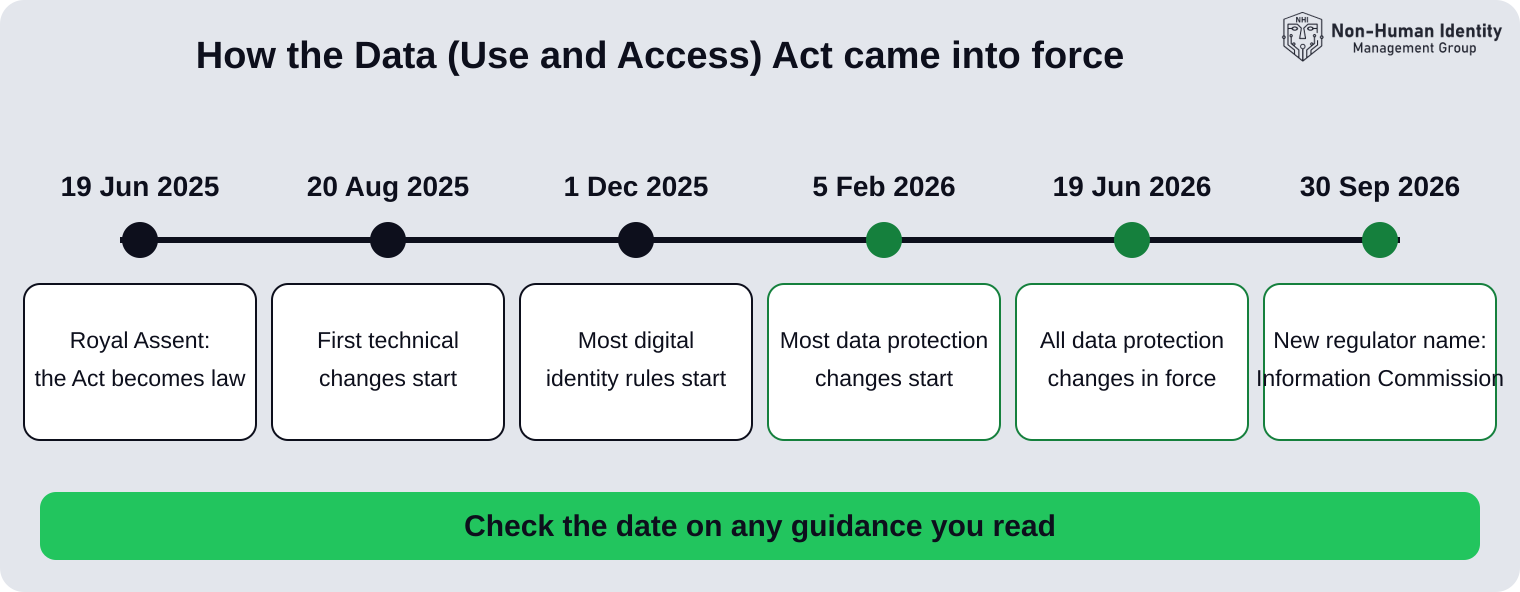
Here is how the Act moved from a bill to the rules people follow today.
- It became law. The Act received Royal Assent, the formal approval that turns a bill into law, on 19 June 2025.[2]
- Parts started in stages. The government turned parts on one stage at a time. The first technical changes began on 20 August 2025.[2]
- Digital identity came next. Most rules on trusted digital ID services began on 1 December 2025.[2]
- Most privacy changes followed. Most of the data protection part started on 5 February 2026. The regulator says all its data protection changes were in force by 19 June 2026.[1][2]
- The regulator changed shape. On 30 September 2026 the Information Commission took over from the Information Commissioner's Office. Its role and powers stay the same. A board now shares decisions.[4]
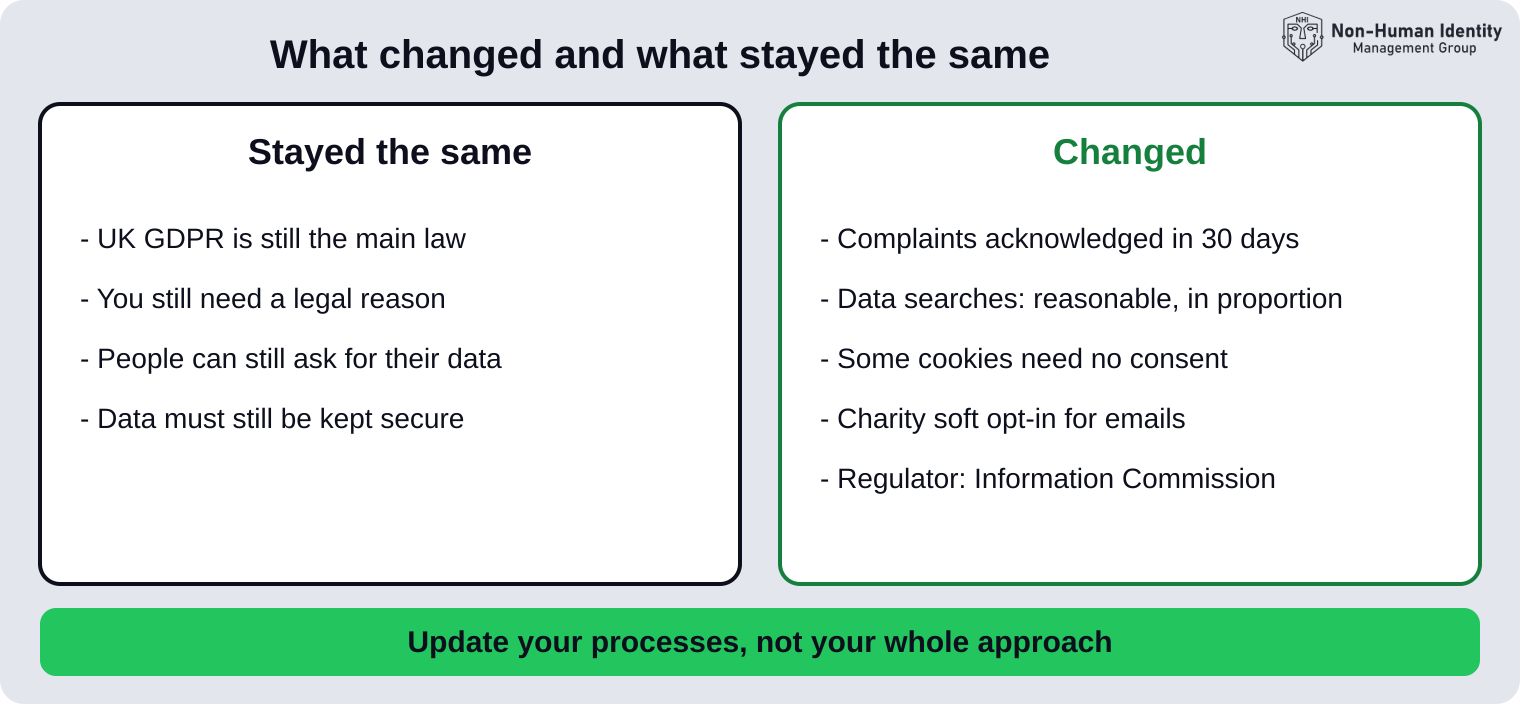
The main changes, in plain words, are these.[1]
- Complaints: organisations must help people complain, for example with an online form. They must acknowledge a complaint within 30 days and deal with it without undue delay.
- Requests to see your data: organisations need only make reasonable and proportionate searches.
- Recognised legitimate interests: for some set purposes, such as public security, organisations no longer need to weigh the benefits against the effect on people.
- Automated decisions: more legal reasons can support important decisions made by software alone, with safeguards. This does not extend to the most sensitive kinds of data.
- Cookies: some cookies, such as those for statistics or to improve how a site works, can be set without consent.
- Charities: a charity can email people who have supported it or shown interest, unless they object.
- Children: online services likely to be used by children must take their needs into account.
A worked example
Talia Mbeki runs Bramble Lane Bakery, a fictional shop that also sells cakes online. She keeps customer names, addresses and order histories. In autumn 2026 she reads that UK privacy law has changed, and she wants to know what it means for her.
She asks Odile Kader, the freelancer who looks after her website, to go through the "Am I affected?" checklist with her.
The first question is about complaints. Talia realises that customers can only complain by phone. Odile adds a simple online form for privacy questions and complaints. Talia sets a reminder so each complaint gets a reply saying it has arrived, well within 30 days.
Next they look at the website's cookies. The shop uses a basic visitor-count tool. Odile checks current regulator guidance and finds that statistics cookies like this may no longer need a consent pop-up, if the conditions are met. They decide to keep the banner for now and review it with the guidance in front of them.
Then they check the privacy notice. It still names the Information Commissioner's Office as the regulator. Odile updates it to the Information Commission.
A month later a customer, Lars Quist, uses the new form to ask what data the bakery holds about him. Talia searches her order system and email, which is a reasonable and proportionate search for a shop her size. She sends him a copy of his details.
Talia writes down what she checked and when. If the rules change again, she knows where to start.
Myths and mistakes
| What people think | What is true |
|---|---|
| The new Act replaced the UK GDPR. | The UK GDPR still applies. The Act changed parts of it. |
| Cookie banners are no longer needed. | Only some cookies, such as statistics cookies, may be set without consent. Others, such as advertising cookies, generally still need it. |
| Small firms do not need a complaints process. | Organisations must help people complain and acknowledge complaints within 30 days. |
| Searches for a person's data no longer matter. | Searches must still be reasonable and proportionate. That is a limit, not a free pass. |
| The new regulator has new powers to ignore old rules. | The change of name and structure did not change the regulator's role or powers. |
What can I do this week?
- Check that people can easily complain to you about their data, for example with a web form.
- Find any paper or web page that names the old regulator, and plan to update it.
- List the cookies your website uses and check them against the latest guidance.
- Look at the date on any privacy training or advice you use.
Checklist
- People can make a data protection complaint easily, for example online.
- Complaints are acknowledged within 30 days and handled without undue delay.
- Staff know how to run reasonable and proportionate searches for a person's data.
- Cookie settings have been checked against current guidance.
- Any decisions made only by software have safeguards, including a way to ask for a person to review them.
- Privacy notices and policies name the Information Commission.
- The date of your last privacy review is recorded.
Common questions
Does the UK GDPR still apply?
Yes. The UK GDPR is still the main privacy law in the UK. The 2025 Act changed parts of it. It also changed the Data Protection Act 2018 and the rules on email marketing and cookies. You read them together.
Is the ICO still the regulator?
The work goes on under a new name. On 30 September 2026 the Information Commission took over the functions of the Information Commissioner's Office. The government says the regulator's role, responsibilities and powers did not change. A board now shares responsibility for decisions.
When did the changes start?
They started in stages. The Act became law on 19 June 2025. Most data protection changes started on 5 February 2026, and the regulator says all of them were in force by 19 June 2026. A few other parts of the Act start later.
Can I now complain straight to the regulator?
You can, but the organisation comes first in most cases. The Act requires organisations to help people complain and to acknowledge complaints within 30 days. If you are unhappy with the answer, the regulator's website explains how to raise a concern with it.
Where next?
Ready for the detail? Read the practitioner guide: UK Data Act 2025 Guide. It goes further into each part of the Act, the commencement regulations behind each date and the control changes for security and identity teams.
Also useful:
- UK GDPR for Beginners
- Subject Access Requests for Beginners
- Cookie Consent Banners for Beginners
- Lawful Basis for Processing for Beginners
Related NHI Mgmt Group resources: UK GDPR and Data Protection Act 2018 Guide · PECR Guide · UK GDPR vs EU GDPR
Key terms
- UK GDPR
- The UK's main data protection law, setting rules for using and protecting personal data.
- Personal data
- Information that can identify a person directly or indirectly, such as a name or account number.
- PECR
- The UK rules on electronic marketing, cookies and some communications services.
- Subject access request
- A request by a person to see the personal data an organisation holds about them.
- Recognised legitimate interests
- A legal reason added by the Act for set purposes, such as public security, that needs no balancing test.
- Small pieces of data a website stores in your browser to remember things about your visit.
- Commencement
- The date when a part of a new law starts to apply.
Sources and further reading
- The Data (Use and Access) Act 2025: what does it mean for organisations? Information Commissioner's Office, published 19 June 2025, updated 19 June 2026. https://ico.org.uk/about-the-ico/what-we-do/legislation-we-cover/data-use-and-access-act-2025/the-data-use-and-access-act-2025-what-does-it-mean-for-organisations/, accessed 28 Nov 2026.
- Data (Use and Access) Act 2025: plans for commencement. Department for Science, Innovation and Technology, GOV.UK, updated 12 October 2026. https://www.gov.uk/guidance/data-use-and-access-act-2025-plans-for-commencement, accessed 28 Nov 2026.
- Data (Use and Access) Act 2025 (2025 c. 18). legislation.gov.uk, The National Archives. https://www.legislation.gov.uk/ukpga/2025/18/contents, accessed 28 Nov 2026.
- Information Commission succeeds the ICO as UK's data protection regulator. GOV.UK, 30 September 2026. https://www.gov.uk/government/news/information-commission-succeeds-the-ico-as-uks-data-protection-regulator, accessed 28 Nov 2026.