A verification code scam tricks you into sharing a one-time code so a criminal can get into your account.
This guide is for anyone who gets sign-in codes by text, email or app and wants to know why people ask for them. You do not need to be online much to be a target: one code read out on the phone can be enough.
In short
- A verification code is a short, one-use code that proves it is you signing in or making a change.
- Criminals start a sign-in with your phone number, then trick you into passing on the code you receive.
- Banks and genuine fraud teams do not ask you to read out these codes, so treat any such request as a scam.
- If you shared a code, act fast: secure the account, call your bank on a trusted number and report it.
What you will learn
- Explain what a verification code is for.
- Spot the common excuses people use to ask for one.
- Check your key accounts for extra protection.
- Know what to do first if you have already shared a code.
- Sign-in code (one-time password)
- a short code sent to you that works once, to prove it is really you.
- Extra sign-in step (two-step verification)
- a second check, such as a code or PIN, on top of your password.
What is a verification code scam?
Think of a code for a parcel locker. Whoever types in the code gets the parcel, and the locker does not check who they are. A verification code works in a similar way for your accounts.
When you sign in, reset a password or set up an app on a new phone, the service may send you a code. Typing it in proves you have your phone. It is an extra lock on top of your password.[2]
In a verification code scam, the criminal starts that sign-in themselves, using your phone number or email. The service sends the code to you. The criminal then tricks you into passing it on.[1][4]
Where the comparison stops working: a parcel locker code opens one box once. A shared sign-in code can let a criminal take over a whole account and lock you out.[4]
Why does it matter?
The code is often the last thing standing between a criminal and your account. Once they have it, they may move money, read your messages or pretend to be you.[2]
If you use WhatsApp or other chat apps
What could happen: a "friend" whose account was taken over asks for a code, and you lose your account the same way.
Check this: turn on two-step verification in the app's settings.
If you bank online
What could happen: a caller posing as your bank's fraud team asks for a code, then uses it to get into your account.
Check this: hang up and call your bank on the number on your card or statement.
If you sell things online
What could happen: a "buyer" asks for a code to prove you are real, and uses it to set up an account in your name.
Check this: never share a code with a buyer, whatever reason they give.
What does it look like?
Example only. All values are made up.
Text from FakeChat:
  Your FakeChat code: 000-000. Do not share  (1)
  this code with anyone.
Message from "Darius" (a friend's account):
  Hi! Sorry, I sent my code to your phone    (2)
  by mistake. Can you send it back to me?     (3)
  Quick, it runs out soon!                    (4)
- The code arrived because someone tried to sign in to your account with your number.
- A message from a contact you know, sent just after the code.
- A believable excuse for why the code came to you. In a real message, this would come from the friend's hijacked account.
- Pressure to act before you have time to think.
Why this is risky: the code is for your account, not your friend's. Sending it hands your account to whoever asked.[4]
The safer way: do not send the code. Call your friend on their usual number to check whether the message is really from them.
How does it work?
This is a simple view so you can spot it. It is not a guide to doing it.
- They start a sign-in. The criminal types your phone number or email into an app or website.
- The code comes to you. The service sends a one-time code to your phone or inbox.
- They contact you. They pose as a friend, your bank or a buyer.[1][2]
- They ask for the code. They give a reason that sounds harmless or urgent.
- They take over. With the code, they get in and may lock you out, then target your contacts next.[4]
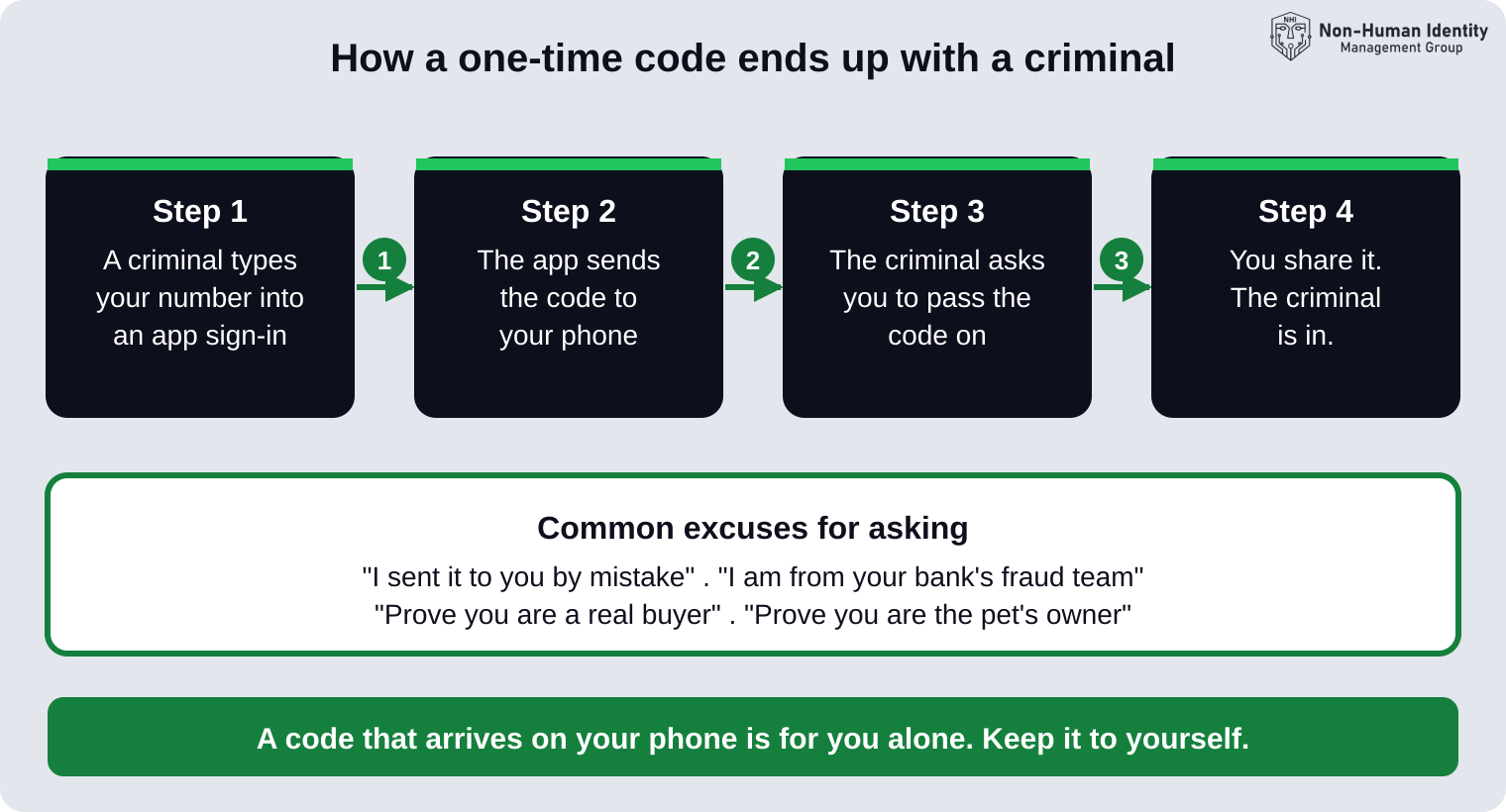
US consumer protection officials say that anyone who asks for your code, when you did not contact them first, is a scammer.[1][3] UK police have warned about the same trick on WhatsApp, where a hijacked friend's account asks for your six-digit code.[4]
A worked example
This story is made up to show how it can happen.
Milo Osei is a student who uses his phone for everything. One evening he gets a text with a six-digit chat app code. He did not ask for one.
A minute later, a message arrives from his friend Darius Whitlock. "Sorry, I sent my code to your number by mistake," it says. "Can you send it back? Quick, it runs out!"
Milo nearly replies with the code. Then he reads the text again. It says the code is for his own account and should not be shared.
He calls Darius on his normal number. Darius picks up, confused. He did not send any message. His account had been taken over earlier that day.
Milo does not share the code. He turns on two-step verification in the app, so a PIN is needed as well as a code. Darius uses the app's help pages to get his account back. He then tells his contacts to ignore any odd requests.
A week later, Milo's neighbour Petra Fairweather gets a call from "her bank". The caller asks her to read out a code to stop a fraud. Milo has told her about his close call, so she hangs up. She calls her bank on the number on her card. The bank confirms it never called.
What made the difference: Milo and Petra checked through a channel they already trusted before sharing anything.
Myths and mistakes
| What people think | What is true |
|---|---|
| If it is a friend asking, it is safe to share the code. | Their account may already be taken over. Call them on their usual number first.[4] |
| My bank's fraud team may need my code to protect me. | Genuine fraud teams do not ask for these codes. A caller who does is a scammer.[3] |
| A code is harmless without my password. | Some sign-ins, such as setting up a chat app on a new phone, need only your number and the code.[4] |
| A buyer asking for a code just wants to check I am real. | This is a known scam. The code can be used to set up a number or account in your name.[1] |
| Once I share a code, there is nothing I can do. | Acting fast helps. Secure the account, call your bank on a trusted number and report it.[3] |
What can I do this week?
- Turn on two-step verification, or a PIN, in WhatsApp and your other chat apps.[4]
- Read the wording of the next code you get. Most say who it is for and not to share it.
- Save your bank's number from your card or statement in your contacts.
- Tell family members, especially older relatives and teenagers, that genuine callers do not ask for codes.
Checklist
- I never share a code that arrives on my phone or in my email.
- I treat any request for a code as a warning sign, even from a friend.
- I check strange requests by calling the person on a number I already know.
- My chat apps have two-step verification or a PIN turned on.
- I know to call my bank on the number on my card, not one a caller gives me.
- I know where to report a scam: Report Fraud, or Police Scotland in Scotland.
Common questions
Why did I get a code I did not ask for?
Usually because someone typed your number or email into a sign-in or reset page. It might be a mistake, or it might be a criminal. Either way, do not share the code. If codes keep arriving, change your password and check your account's security settings.
What should I do if I already shared a code?
Act straight away. Try to sign in and change your password, then turn on extra protection. If it was a bank code, call your bank on the number on your card. Warn your contacts, because a criminal may message them from your account.
Is it ever safe to read a code to someone?
Very rarely. The safe rule is to share a code only when you contacted the company first, on a number you found yourself. US consumer officials say a request from someone who contacted you is a scam.
Are authenticator apps or passkeys safer than text codes?
They help. An authenticator app makes codes on your own phone, and a passkey signs you in without a code to read out. You should still never pass any code to anyone who asks for it.
Where next?
Ready for the detail? Read the practitioner guide: Verification Code Scams Guide. It goes further into the common scripts, what each code unlocks and what organisations can do to cut these scams.
Also useful:
- SIM Swap Fraud for Beginners
- Account Takeover for Beginners
- Phone Scams for Beginners
- Multi-Factor Authentication for Beginners
- Strong Customer Authentication for Beginners
Related NHI Mgmt Group resources: OTP security · Two-Factor Authentication for Everyone Guide · Passkeys for Everyone Guide
Key terms
- One-time password
- A short code that works once, sent or shown to you to prove it is you.
- Multi-factor authentication
- Asking for two or more kinds of proof, such as a password and a code, before letting you in.
- Account takeover
- When someone else gets into your account and uses it as if they were you.
- Tricking people into handing over information or access by playing on trust or hurry.
- Bank impersonation scam
- A scam where someone pretends to be from your bank to get codes, details or money.
- Passkey
- A way to sign in without a password, where a secret key stays on your device.
Sources and further reading
- The Google Voice scam: how this verification code scam works and how to avoid it. Federal Trade Commission (FTC), consumer alert, 29 October 2021. https://consumer.ftc.gov/consumer-alerts/2021/10/google-voice-scam-how-verification-code-scam-works-and-how-avoid-it, accessed 28 Nov 2026.
- What's a verification code and why would someone ask me for it? Federal Trade Commission, Military Consumer, 7 March 2024. https://www.militaryconsumer.gov/blog/whats-verification-code-why-would-someone-ask-me-it, accessed 28 Nov 2026.
- Got a call about fraud activity on your bank account? It could be a scammer. Federal Trade Commission (FTC), consumer alert, 2024. https://consumer.ftc.gov/consumer-alerts/2024/06/got-call-about-fraud-activity-your-bank-account-it-could-be-scammer, accessed 28 Nov 2026.
- Warning issued to WhatsApp users over account takeover scam. Action Fraud (now Report Fraud), 27 March 2023, as republished by WiredGov. https://wired-gov.net/wg/news.nsf/articles/Warning+issued+to+WhatsApp+users+over+account+takeover+scam+27032023122500, accessed 28 Nov 2026.