Moving from the military into cyber security means turning service skills into a civilian security job.
This guide is for serving personnel, recent service leavers, reservists and their families who want a first, plain picture of the move. You do not need a technical trade to start: many security jobs value the planning, discipline and calm under pressure that service builds.
In short
- Your skills are real, but civilian employers often do not understand military job titles, so you need to translate them.
- Free public tools match military jobs to civilian ones, and a shared list of cyber work roles helps you pick a target.
- The UK and US both run support schemes that start well before you leave, so plan early.
- Choose a target role first, then spend any training money on what that role needs.
What you will learn
- Explain how military experience maps to civilian security roles.
- Spot the jargon on a CV that a civilian recruiter will not understand.
- Check which transition support you may be able to use, and when it starts.
- Ask the right questions before you spend training money.
- Leaving the forces (resettlement or transition)
- the support and time given to service people to prepare for civilian work.
- Skills that carry over (transferable skills)
- abilities, such as planning or briefing, that are useful in many jobs.
- A shared list of cyber jobs (NICE Framework)
- a US public list that describes cyber security work as roles with tasks and skills.
What is moving from the military into cyber security?
Think of changing money at a bureau de change before a trip abroad. Your money keeps its value, but the shops abroad only take the local currency. Your service skills work the same way.
You may have run a network, handled secret material or led a team under pressure. Those skills count in security work. But a recruiter may see only rank, unit names and short forms on your CV. So the move is mostly about putting what you did into words and proof that employers know.
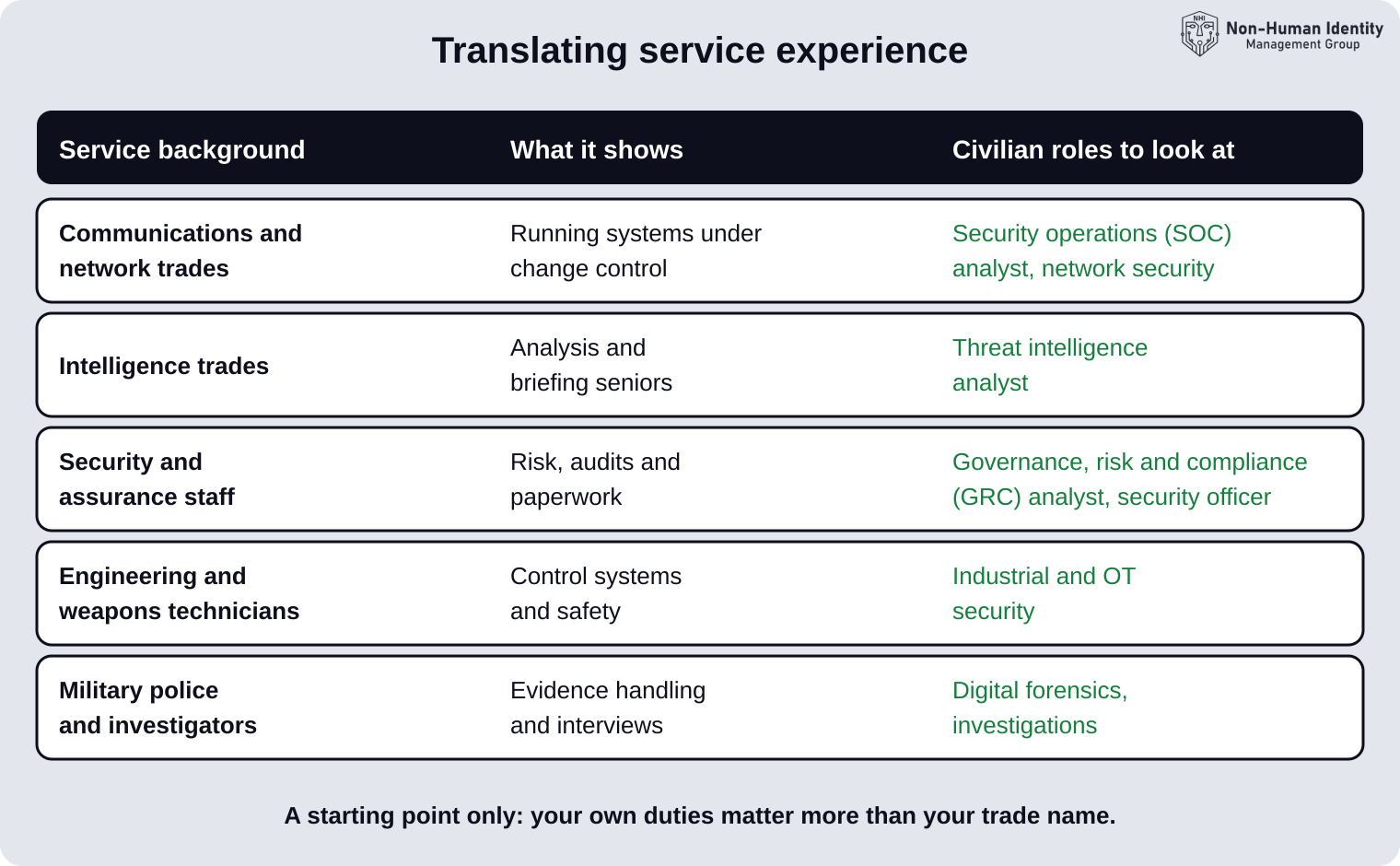
Cyber security covers many jobs. Some people watch for attacks. Some manage risk and rules. Some protect factories and power plants, and some look into attacks after they happen. Each service job fits some of these better than others, so part of the move is picking your best fit.
Where the comparison stops working: money changes at a set rate. Your skills do not. Some carry over almost fully. Others need extra training or a known certificate before an employer will count them.
Why does it matter?
Many service leavers have useful experience and support they could use. Leaving the planning too late can mean missing help that only runs while you are still serving.
If you are still serving
What could happen: you start planning a few months before you leave and miss support that opens years earlier.
Check this: ask your education or resettlement staff what you can use, and from when.
If you have already left
What could happen: you apply for dozens of jobs with a CV full of service terms and hear nothing back.
Check this: ask a civilian friend to read your CV and circle every word they do not understand.
If you hire security staff
What could happen: you filter out strong candidates because their CVs do not use civilian job titles.
Check this: read for tasks and results, not titles, and ask candidates to explain their duties.
What does it look like?
Here is a made-up skills translation card. It shows how one service duty can be rewritten for a civilian reader.
Example only. All values are made up.
Skills translation card (FAKE)
Service wording: "Det IC, EXAMPLE Sqn, ran CIS on Op FAKE"     (1)
Civilian wording: "Led a team of 6 running a 400-user
                   network on a deployed operation."           (2)
What it shows:    leadership, running systems under
                  strict change control                        (3)
Target role:      security operations (SOC) analyst            (4)
Gap to close:     modern monitoring tools, one entry-level
                  certificate                                  (5)
- Service shorthand. A civilian recruiter is unlikely to understand it.
- The same duty in plain words, with numbers and scope.
- The skills the duty proves, in words employers use.
- One target role, chosen before any training is booked.
- In a real file, this line would contain the honest gap between your experience and the role.
Why this is risky: a CV written in service shorthand is easy to pass over. Listing every possible role also makes it harder for an employer to see where you fit.
The safer way: rewrite each duty as a result, with numbers. Pick two or three neighbouring roles, and be open about the gap you are closing. Describe sensitive work only by type and size, never by content, and follow your service's rules on what you may say.
How does it work?
Most moves follow a similar path. The exact support depends on your country, service and time served.
- Start early. In the UK, the main resettlement programme is available from two years before discharge for people with more than six years' service.[1] In the US, the SkillBridge scheme lets people train with an employer in their last 180 days of service.[2]
- Translate your job. A free US government tool lets you search by military job code and see related civilian jobs.[3]
- Pick target roles. The NICE Framework describes 52 cyber work roles. It points out that a work role is not the same as a job title.[4] Choose two or three roles that fit your experience.
- Close the gap. Book training that the target role needs. Check what funding you can use first, because each scheme has its own rules and limits.
- Get civilian proof. Rewrite your CV in civilian words, add any new certificate, and practise explaining your work to someone outside the forces.
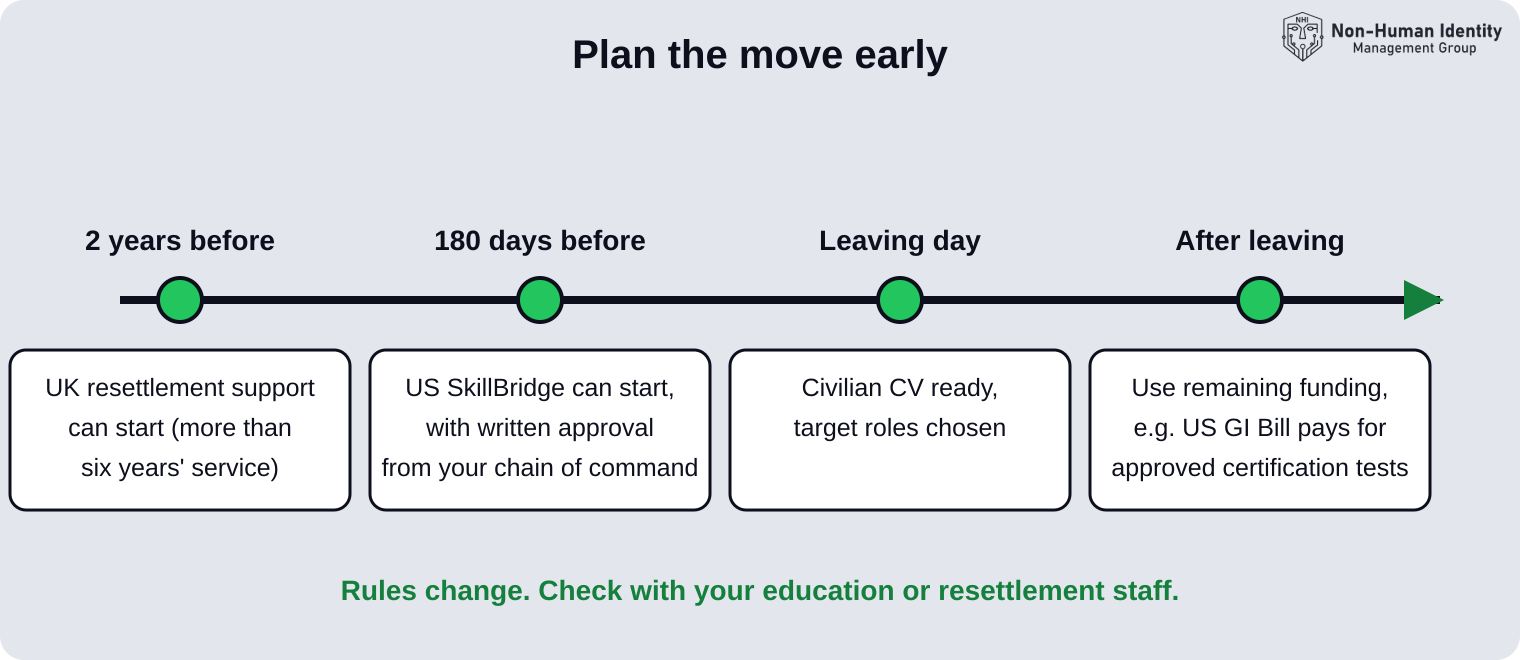
Funding varies. In the US, the GI Bill can repay the cost of approved licence and certification tests, up to $2,000 per test.[5] In the UK, Enhanced Learning Credits help service people pay for recognised qualifications at Level 3 or above.[6] SkillBridge needs written approval from your chain of command, and you keep your military pay while you take part.[2]
A worked example
Bruno Mbeki is a fictional RAF communications technician with eight years' service. He plans to leave in about two years and wants a job in cyber security, but he is not sure where to start.
He books a meeting with his resettlement adviser. She tells him his resettlement support can start now, not just in his final months. Bruno is surprised. He had planned to think about it next year.
Next, Bruno reads about cyber work roles. He likes the idea of watching for attacks in a security operations centre (SOC), a team that monitors an organisation's systems. He also notes governance and risk work as a second option.
He writes his first civilian CV. Then he asks his friend Kemal Quist, who left the Army three years ago and now works in IT, to read it. Kemal circles eleven acronyms and two unit names. "Nobody outside will know what these mean," he says. Bruno rewrites each duty as a result, with numbers.
His adviser helps him check what funding he can use for an entry-level security certificate. Bruno studies in the evenings and passes it a year before he leaves.
Six months before his leaving date, he talks to Reza Okafor, who manages a SOC team at a civilian firm. Reza says Bruno's experience with change control and night shifts fits the work well. What he needs is time on modern monitoring tools. Bruno accepts a junior analyst role, knowing his leadership experience should help him move up once he has learned the tools.
Myths and mistakes
| What people think | What is true |
|---|---|
| I need a technical trade to get into cyber security. | Technical roles need technical skills, but risk, compliance and investigation roles also value planning, writing and judgement. |
| My rank will carry over to a senior job. | Many leavers start one step lower to learn civilian tools, then move up as their experience is recognised. |
| I will sort it out in my last few months. | Some support starts much earlier, up to two years before discharge in the UK.[1] |
| More certificates always help. | A certificate helps most when it matches a target role. Pick the role first, then the training. |
| I cannot talk about my work at all. | You can usually describe the type and size of work without the content. Follow your service's rules on what is allowed. |
What can I do this week?
- Ask your education or resettlement staff what support you can use, and when it starts.
- Search your military job code in a civilian job crosswalk tool.
- Read about two or three cyber work roles and pick the closest fit.
- Rewrite one duty from your service record as a plain result with numbers.
- Ask a civilian friend to read your CV and mark any words they do not understand.
Checklist
- I know when my transition support opens and when it closes.
- I have chosen two or three target roles, not ten.
- My CV uses civilian words, with numbers and results.
- Sensitive work is described by type and size only, within my service's rules.
- Any training I book matches my target roles.
- I have checked funding rules and limits before paying for anything.
- A civilian has read my CV and understood it.
- I have spoken to at least one person already working in my target role.
Common questions
Which cyber security jobs suit service leavers?
Many do. Watching for attacks, handling incidents, threat research, risk and rules work, factory system security and investigations often suit service people. The best fit depends on your own duties. So match what you did to the tasks of each role before you choose.
Do I need a degree to get into cyber security?
Not always. Many first jobs ask for proof of skills, such as a known certificate and some related work, rather than a degree. Some employers and some government jobs do ask for one, so check the adverts for the jobs you want.
When should I start planning my move?
As early as you can. UK resettlement support can open up to two years before discharge, depending on time served. In the US, SkillBridge runs in the last 180 days and needs command approval, so plan well before that window opens.
Does a security clearance help?
It can. Some employers, mostly in defence and government work, need staff who hold or can get a clearance. Ask employers and your service how a clearance carries over once you leave. The rules differ by country and by level.
Will I have to start at the bottom?
Often one step lower than your rank suggests, but not at the very bottom. Employers value leadership and judgement, but want to see civilian tool skills first. Many leavers move up quickly once they have that experience.
Where next?
Ready for the detail? Read the practitioner guide: Military to Cyber Security Career Guide. It goes further into a detailed trade-to-role table, the funding schemes in the UK and US, and how to describe classified work on a CV.
Also useful:
- Career Change into Cyber Security Guide
- NICE Workforce Framework Guide
- Cyber Security Certifications for Beginners
- SOC Analyst for Beginners
- GRC Analyst for Beginners
Related NHI Mgmt Group resources: Cybersecurity Careers Guide · Threat Intelligence Analyst for Beginners · OT Security Engineer for Beginners
Key terms
- Transferable skills
- Skills that carry across jobs and industries, such as planning, analysis or leading people.
- NICE Framework
- A shared US list that describes cyber security work as roles, tasks and skills.
- Veteran talent pipeline
- The hiring, training and progression paths that bring service people into civilian cyber roles.
- Security clearance
- Official approval, after checks, for a person to handle protected information.
- Certification
- A recognised qualification, usually gained by passing an exam, that shows a set level of skill.
- SOC analyst
- A person who watches an organisation's systems for signs of attack and checks alerts.
Sources and further reading
- Career Transition Partnership. Ministry of Defence, GOV.UK. https://www.gov.uk/guidance/career-transition-partnership, accessed 28 Nov 2026.
- DOD SkillBridge: Program overview. US Department of Defense. https://skillbridge.osd.mil/program-overview.htm, accessed 28 Nov 2026.
- Military Crosswalk Search. O*NET OnLine, US Department of Labor. https://www.onetonline.org/crosswalk/MOC/, accessed 28 Nov 2026.
- The NICE Framework. NICCS, Cybersecurity and Infrastructure Security Agency. https://niccs.cisa.gov/workforce-development/nice-framework, accessed 28 Nov 2026.
- Reimbursement for licensing and certification tests. US Department of Veterans Affairs. https://www.va.gov/education/about-gi-bill-benefits/how-to-use-benefits/test-fees/, accessed 28 Nov 2026.
- Enhanced Learning Credits. Discover My Benefits, Ministry of Defence. https://discovermybenefits.mod.gov.uk/army/professional-development/enhanced-learning-credits/, accessed 28 Nov 2026.