NYDFS Part 500 is a New York rule that makes licensed financial firms run a cyber security programme.
This guide is for anyone who works at, or with, a bank, insurer or lender in New York and wants a plain picture of the rule. You do not need to be in IT to be affected: the rule touches sign-in, training, suppliers and what leaders sign.
In short
- Part 500 is a cyber security rule from New York's financial regulator, the Department of Financial Services (DFS).
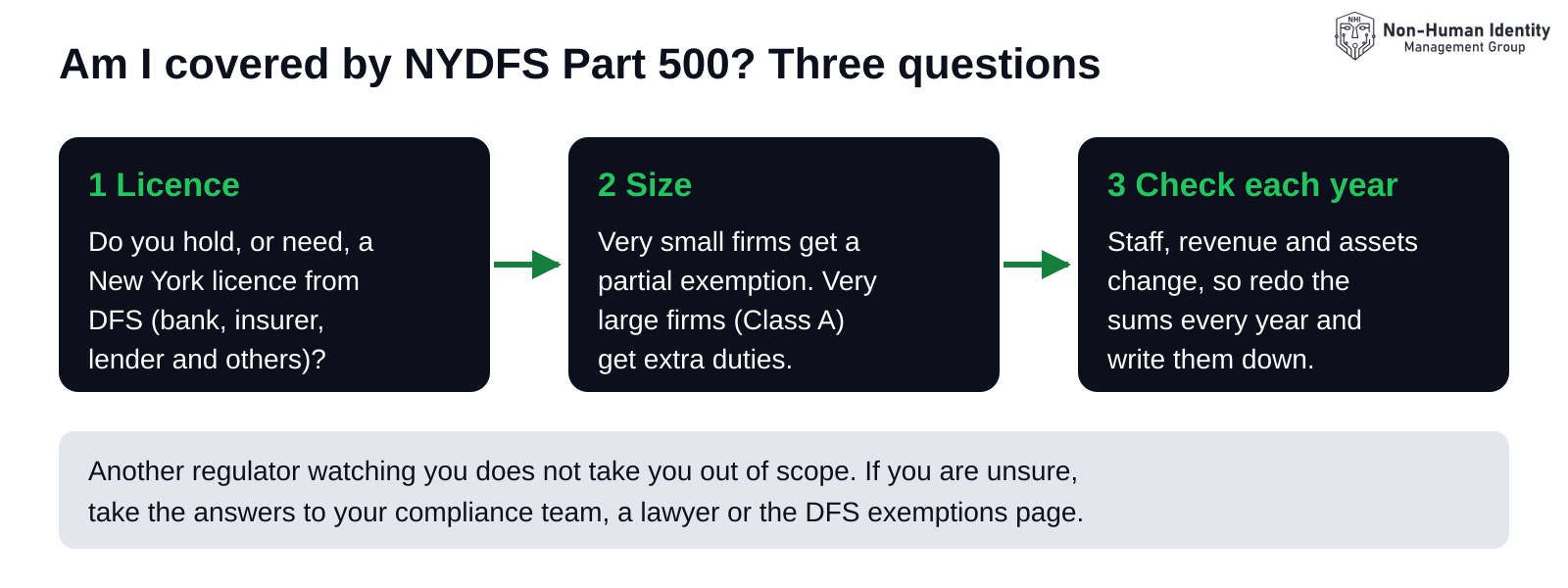
- It applies to firms that hold, or need, a DFS licence, such as banks, insurers and lenders, even if another regulator also oversees them.
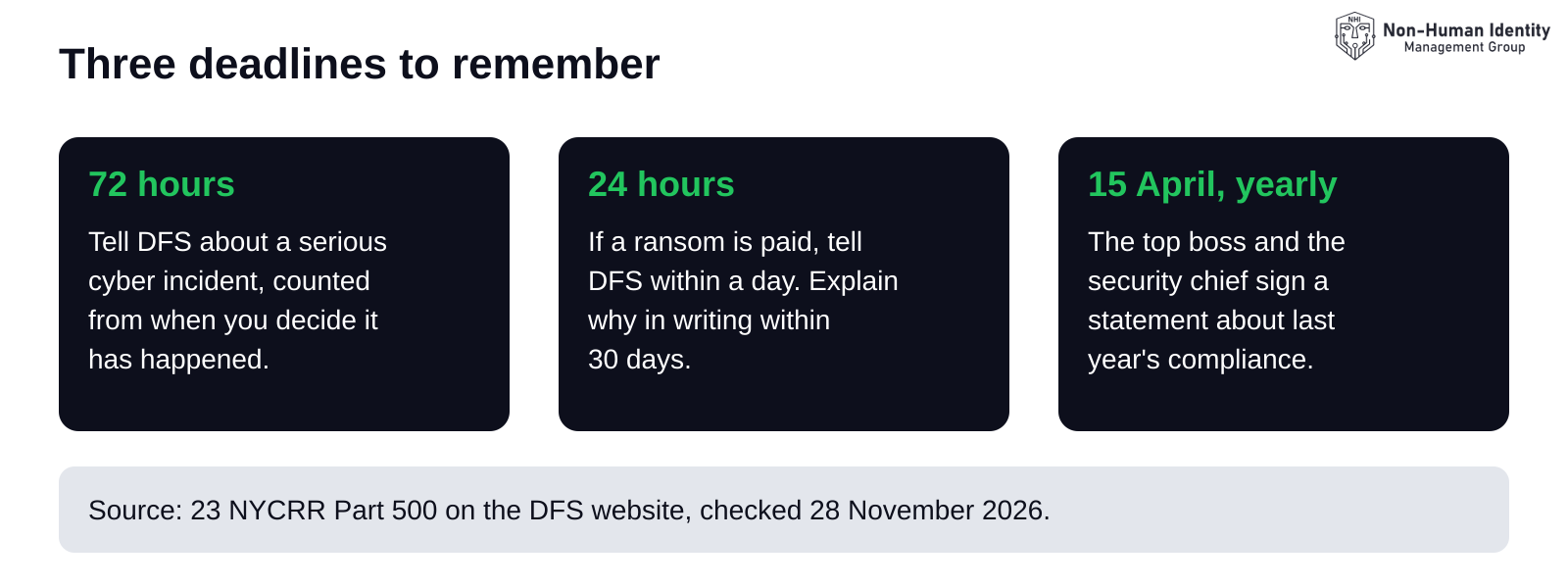
- Firms must report a serious cyber incident to DFS within 72 hours, and a ransom payment within 24 hours.
- Each year by 15 April, the top boss and the security chief sign a statement about the year before.
What you will learn
- Explain what Part 500 is in one sentence.
- Check the three questions that decide if a firm is covered.
- Spot the three deadlines that matter most.
- Ask the right questions of your security or compliance team.
Status: correct as at 28 November 2026, based on the text of 23 NYCRR Part 500 and the cybersecurity pages on the DFS website. Rules change; check the official text.
This guide explains the topic in general terms and is not legal advice.
- Covered firm (covered entity)
- a business the rule applies to because it holds a New York financial licence.
- Serious cyber problem (cybersecurity incident)
- an attack or failure big enough that the rule says DFS must be told.
- Security chief (CISO)
- the person in charge of a firm's cyber security programme.
What is NYDFS Part 500?
Think of a food hygiene licence. To keep serving food, a kitchen must follow set rules. Inspectors can visit, and the owner must act when something goes wrong.
Part 500 works the same way for cyber security in New York finance. DFS is the state body that licenses banks, insurers and many other money firms. In 2017 it made a rule that these firms must protect their computer systems and the customer data inside them.[1]
The full name is 23 NYCRR Part 500. That is simply where the rule sits in New York's book of state rules. DFS updated it in a big way in November 2023, and the new duties came in step by step until November 2025.[2]
Where the comparison stops working: a hygiene inspector checks one kitchen at a time. Under Part 500, the firm's own leaders must sign a yearly statement saying whether they met the rule.
Why does it matter?
Banks and insurers hold money and private data for millions of people, so one break-in can hurt many customers at once.
If you supply a New York financial firm
What could happen: covered firms must have written rules for checking their suppliers' security. Expect security questions and contract terms from them.
Check this: ask your customer what security evidence they expect from you.
If you are a senior leader or board member
What could happen: the top boss signs the yearly statement. The board must also understand cyber risk well enough to oversee it.
Check this: ask when the board last received a written cyber report from the security chief.
If you work in IT or operations
What could happen: you may be the first to see an attack, and the report to DFS can be due within 72 hours.
Check this: find out who decides that an incident is serious, and how to reach them out of hours.
What does it look like?
Here is a short "Am I covered?" card for a made-up firm. It shows the questions a firm works through first.
Example only. All values are made up.
AM I COVERED? (scenario card)
Company:  EXAMPLE Lending (FAKE)
Licence:  New York lender licence from DFS   (1)
Other regulator too?  Yes                    (2)
Staff:    0000 placeholder, about 60 people  (3)
Size:     not very small, not very large
Result:   LIKELY covered, full rule          (4)
Next step: confirm with compliance or a lawyer
- A DFS licence is what brings a firm into scope.
- Another regulator does not take the firm out of scope.
- About 60 staff is above the small-firm line of 20 staff.
- In a real file, this line would contain the firm's reasons and who checked them.
Why this is risky: some firms assume a federal regulator or their small size means Part 500 does not apply, and find out late.
The safer way: fill in the card each year, write down the numbers you used, and check them against the DFS exemptions page.[4]
How does it work?
Here is how Part 500 applies to a firm, in general terms.
- Check if you are covered. The rule applies to anyone working under a DFS licence, charter or similar permission, even if another body also regulates them.[2]
- Find your size group. Firms with fewer than 20 staff, under 7.5 million dollars of yearly revenue, or under 15 million dollars of assets get a partial exemption. The largest firms, called Class A, get extra duties. Firms that qualify for an exemption tell DFS by filing a notice.[2][4]
- Build the programme. Do a risk assessment, which means listing what could go wrong and how badly. Then write policies, name a security chief and train every member of staff each year.[2]
- Control who gets in. Give people only the access their job needs, review access at least once a year and remove leavers promptly. Use multi-factor authentication, which means a second proof beyond a password, for anyone signing in.[2]
- Report and certify. Tell DFS about serious incidents within 72 hours. Each April, sign a yearly statement about last year.[2]
Part 500 also covers ten other areas, such as backups, suppliers and a list of the firm's computers and software. The practitioner guide goes through each one. The deadlines are the part most people need to remember.
A worked example
Hudson Gate Lending is a made-up mortgage lender in New York with about 60 staff. Its new compliance manager, Pia Holm, is asked a simple question by the chief executive: "Are we covered by Part 500?"
Pia fills in an "Am I covered?" card. The firm holds a DFS lender licence, and it has more than 20 staff and too much revenue for the small-firm exemption. So the full rule likely applies, though not the extra Class A duties. She writes down the numbers she used.
Next she meets Mo Young, the IT lead who also acts as security chief. They go through the main areas together. Training happens each year, but it does not cover phishing, which is fake messages that trick people. Email uses a second sign-in check, yet the old loan system still takes only a password. Nobody has reviewed who can reach customer files since last spring.
Mo writes a short plan. A second sign-in check for the loan system comes first. Then an access review, a training update and a one-page guide on who reports an incident to DFS, and how fast.
In March, the chief executive and Mo prepare the yearly statement. One gap is still open, so the firm's lawyer advises on which kind of statement fits. They keep the evidence on file in case DFS asks.
Part 500 did not make the firm safe on its own. But the work gave Hudson Gate a clear list of gaps, owners and dates.
Myths and mistakes
| What people think | What is true |
|---|---|
| We are watched by a federal regulator, so New York rules do not apply. | The rule applies to DFS licence holders whether or not other bodies also regulate them.[2] |
| Small firms are fully exempt. | Small firms get a partial exemption. Duties such as sign-in checks, incident reports and the yearly statement still apply.[2] |
| We only report attacks where data was stolen. | Some events count even without stolen data, for example ransomware spreading across a large part of the firm's systems.[2] |
| The yearly statement is a form for the IT team. | The top boss and the security chief both sign it, personally.[2] |
| A second sign-in check is only needed for remote access. | Since November 2025, it applies to anyone signing in to the firm's systems, unless an approved alternative is in place.[2] |
| If we cannot certify, we should say nothing. | A firm that did not fully comply files a different statement, called an acknowledgment, listing the gaps and a plan to fix them.[2] |
What can I do this week?
- Ask your compliance team whether your firm is covered, and which size group it is in.
- Find out who decides that an incident must be reported to DFS, and write their name down.
- Check that every system you use asks for a second sign-in check.
- Read the Part 500 page on the DFS website, including its common questions page.[3]
Checklist
- We know whether we are covered, and in which size group, with the numbers written down.
- We have a named security chief who reports in writing to the board at least once a year.
- Our risk assessment is up to date.
- Every person signing in to our systems uses a second sign-in check, or an approved alternative.
- We review who has access at least once a year and remove leavers promptly.
- All staff get yearly security training that covers tricks such as phishing.
- Our incident plan covers the 72-hour and 24-hour reports to DFS.
- We know who signs the 15 April statement, and where the evidence is kept.
Common questions
When did Part 500 start?
The first version took effect on 1 March 2017. A major update took effect on 1 November 2023, and its new duties came in stages. The last stage, which covered second sign-in checks for everyone and a list of systems, took effect on 1 November 2025.[2]
What is a Class A company?
Class A is the label for the largest covered firms. Very roughly, they have at least 20 million dollars of yearly revenue and either over 2,000 staff or over 1 billion dollars of revenue. They have extra duties, such as independent audits and tighter control of powerful accounts.[2]
What happens if a firm breaks the rule?
DFS can take enforcement action, and a single failure to meet a duty can count as a breach. The rule also says a serious failure lasting 24 hours counts. DFS looks at factors such as how well the firm cooperated and how serious the problem was.[2]
Does Part 500 cover accounts used by software?
Yes, in part. The rule counts service accounts, which are accounts that programs use, as powerful accounts when they can carry out security tasks that ordinary users cannot. That brings them into access limits and reviews. See Non-Human Identities for Beginners.[2]
How is Part 500 different from SOX?
They are separate rules. SOX is a US federal law about honest financial reports by listed companies. Part 500 is a New York rule about cyber security at firms with a DFS licence. Some firms need to think about both. Start with SOX for Beginners.
Where next?
Ready for the detail? Read the practitioner guide: NYDFS Part 500 Guide. It goes further into each section of the rule, the full Class A and exemption tests, the phased dates and how to build the evidence for the yearly statement.
Also useful:
- NYDFS Part 500 Annual Certification Checklist
- Multi-Factor Authentication for Beginners
- Access Reviews for Beginners
- Cyber Security Compliance for Beginners
- Ransomware for Beginners
Related NHI Mgmt Group resources: MFA Mandates Map · Privileged Access Requirements Map · Incident Response Plan Template
Key terms
- NYDFS
- New York's Department of Financial Services, the state body that licenses and oversees many financial firms.
- Covered entity
- A firm the rule applies to, here because it works under a DFS licence or similar permission.
- CISO
- The senior person in charge of a firm's cyber security programme.
- MFA
- Signing in with two or more different kinds of proof, such as a password and a phone app.
- Risk assessment
- A written look at what could go wrong, how likely it is and how much harm it would cause.
- Access review
- A regular check that each person and account still needs the access it has.
- Service account
- An account used by a program rather than a person.
- Ransomware
- Harmful software that locks files and demands payment to unlock them.
Sources and further reading
- Cybersecurity Resource Center. New York State Department of Financial Services; first cybersecurity regulation promulgated 1 March 2017; scope statement for licensed individuals and organisations. https://www.dfs.ny.gov/industry_guidance/cybersecurity, accessed 28 Nov 2026.
- 23 NYCRR Part 500, Cybersecurity Requirements for Financial Services Companies, as amended (second amendment effective 1 November 2023): 500.1(d) Class A company, 500.1(e) covered entity, 500.1(g) cybersecurity incident, 500.1(p) privileged account, 500.4 CISO reporting and board oversight, 500.7 access privileges, 500.9 risk assessment, 500.11 third-party service provider policy, 500.12 multi-factor authentication, 500.14(a)(3) training, 500.17(a) 72-hour notice, 500.17(b) annual certification or acknowledgment by 15 April, 500.17(c) extortion payment notices, 500.19(a) limited exemption, 500.20 enforcement, 500.21 effective dates, 500.22 transitional periods. New York State Department of Financial Services. https://www.dfs.ny.gov/cybersecurity/23-NYCRR-Part-500, accessed 28 Nov 2026.
- Cybersecurity Regulation: Frequently Asked Questions. New York State Department of Financial Services. https://www.dfs.ny.gov/cybersecurity/faqs, accessed 28 Nov 2026.
- Cybersecurity Regulation: Exemptions. New York State Department of Financial Services. https://www.dfs.ny.gov/cybersecurity/exemptions, accessed 28 Nov 2026.