A help desk analyst is the first person staff contact when their computer, account or app has a problem.
This guide is for students, career changers and anyone thinking about a first job in IT. It is also for managers who rely on a help desk. The help desk can reset passwords, so it is also a target for criminals.
In short
- Help desk analysts take calls, chats and tickets from people who need IT help, then fix the problem or pass it on.
- Common tasks include password resets, setting up laptops, managing accounts and explaining software.
- It is a common first job in IT, and some people start without a degree.
- Criminals phone help desks pretending to be staff, so checking who is calling is a core skill.
What you will learn
- Explain what a help desk analyst does in one sentence.
- Describe a typical day, from the first ticket to the last.
- Spot the signs of a caller who may not be who they claim.
- Check which routes into the job fit you.
- Help request record (ticket)
- a written record of one problem, who reported it and what was done.
- Tricking people (social engineering)
- using lies, pressure or a fake identity to get someone to hand over access or information.
- Second check at login (MFA)
- an extra step after the password, such as a code or a tap on a phone, that proves it is really you.
What is a help desk analyst?
Think of a hotel front desk. Guests come with all kinds of problems. The desk fixes the simple ones, calls the right expert for the rest, and checks a guest's ID before handing over a new room key. A help desk does the same for IT.
The US Bureau of Labor Statistics says these specialists "usually provide technical help to non-IT computer users".[1] They help by phone, chat, email or in person. They find out what is wrong, record it, and walk people through the fix.
The job has many names. You may see help desk analyst, service desk analyst, IT support technician or computer user support specialist.
Where the comparison stops working: a hotel guest stands in front of you. A help desk caller is often only a voice or a chat message, so checking identity takes more care.
Why does it matter?
When people cannot log in or work, the business slows down. The help desk gets them going again. It also holds the power to reset accounts, which criminals want.
If you want a first job in IT
What could happen: you skip help desk jobs because they seem too basic, and miss a common way in.
Check this: read your country's official careers profile for IT support and note the career paths it lists.
If you manage a help desk
What could happen: an analyst resets a manager's login for a convincing caller who turns out to be a criminal.
Check this: ask whether staff have a fixed way to confirm a caller's identity before any reset.
If you are a member of staff who calls IT
What could happen: you get annoyed when the help desk asks extra questions, and push them to skip the checks.
Check this: expect to be checked. The same checks protect your account from someone pretending to be you.
What does it look like?
Most help desk work starts as a ticket. Here is a made-up one.
Example only. All values are made up.
Ticket:     EXAMPLE-0000
From:       caller says "Sales Director, J. Example"   (1)
Channel:    phone, from an unknown number                (2)
Request:    "Reset my password and my phone app now.
             I'm about to board a plane."                (3)
Identity check:  not done yet                            (4)
Notes:      new password sent by text                    (5)
- Anyone can claim a name and job title on the phone.
- The call does not come from a number on the staff record.
- Urgency and a senior title are common pressure tactics.
- The reset should wait until this step is done.
- In a real file, this line would show how the new password was delivered. Sending it to a number the caller just gave is risky.
Why this is risky: if the caller is a criminal, a reset hands them the account, including any second check.
The safer way: follow a fixed identity check every time. Call back on the number held on file, and do not skip steps because of urgency.
How does it work?
The UK National Careers Service and the US Bureau of Labor Statistics describe a similar flow of work.[1][2]
- Take the request. Someone calls, chats, emails or raises a ticket to say something is wrong.
- Log it. The analyst records the problem in a tracking system, in the person's own words where possible.
- Check who it is. Before changing any account, the analyst confirms the person is who they say they are.
- Fix or pass on. The analyst solves the problem, or sends it to the right team with clear notes.
- Close and share. They update the ticket and add useful fixes to a shared help library, called a knowledge base.
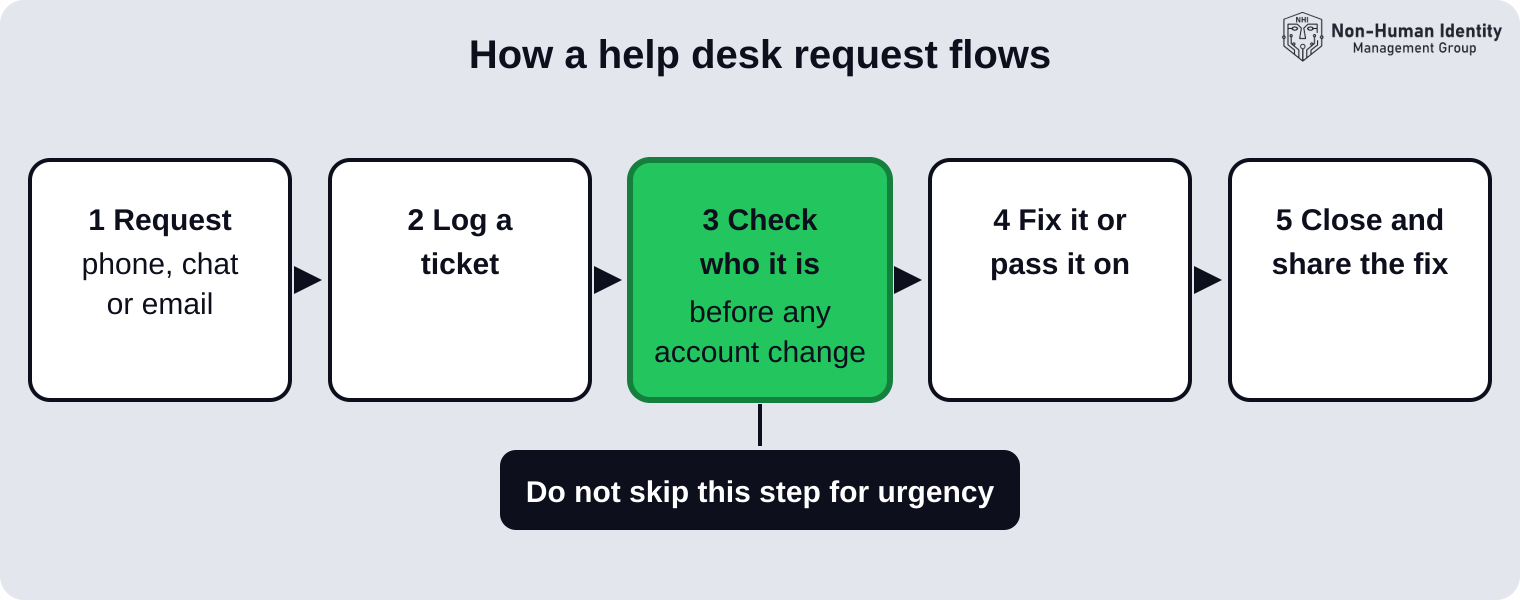
Why identity checks matter in this job
A US government advisory describes a criminal group that targets large companies and their IT help desks. It says the group uses social engineering to convince help desk staff to reset passwords and second checks, then takes over accounts.[3]
The same advisory recommends phishing-resistant MFA where possible. That is a second check, such as a security key, that is much harder to trick people into handing over.[3] For the help desk, the lesson is simple. Resets are powerful, so they need a firm, repeatable check.
Skills and tools
The careers service lists both people skills and technical skills.[2]
- Customer service. Staying patient and clear with people who are stressed.
- Computer basics. How operating systems, hardware and common software work.
- Problem-solving. Asking good questions to find the real cause.
- Ticket systems. Logging, tracking and handing over work so nothing gets lost.
- Healthy suspicion. Following identity checks even when the caller is friendly or senior.
Routes in
In the UK, routes include college courses, apprenticeships, university and starting as a trainee.[2] In the US, these jobs need some computer knowledge but not always a degree. Some people qualify with a high school diploma plus IT certifications.[1] With experience, people move into roles such as network engineer, database administrator or security.[2]
A worked example
Imani Nakamura is a help desk analyst at Cedar Bakery, a fictional bakery chain with twenty shops. She joined through an apprenticeship a year ago.
At 8.00 the queue already has twelve tickets. A shop manager cannot print the day's orders. Imani finds the printer is offline and talks the manager through restarting it. She closes the ticket and adds the fix to the knowledge base.
At 9.30 a new starter, Vik Marlow, needs a laptop and an account. Imani checks the request was approved by his manager. She sets up the laptop with only the apps his job needs.
At 11.15 the phone rings. A caller says she is the finance director, Freya Rinaldi. She is travelling, has a new phone and needs her login and phone app reset now. She sounds stressed and in a hurry.
Imani follows the checklist. She says she will call back on the number held in the staff records. The caller gets angry and hangs up. Imani calls the number on file. The real Freya answers from her office and says she has not called.
Imani reports the call to the security team, with the time, the number used and what was asked. They warn other staff to expect similar calls. Imani's careful check may well have stopped an account takeover.
Myths and mistakes
| What people think | What is true |
|---|---|
| Help desk work is just "turn it off and on again". | Tasks include accounts, security settings, installs, training and keeping a knowledge base.[2] |
| You need a degree to start. | Some employers accept a high school diploma plus IT certifications, and UK routes include apprenticeships.[1][2] |
| A caller who knows personal details must be genuine. | Criminals gather personal details and answer security questions before asking for resets.[3] |
| Being helpful means skipping checks when someone is in a hurry. | Urgency is a common pressure tactic. Follow the same check every time. |
| Help desk is a dead end. | Official careers guidance lists routes on to network, database, systems and security roles.[2] |
What can I do this week?
- Read the official IT support careers profile for your country.
- Practise explaining one simple fix, such as joining Wi-Fi, to a friend who is not technical.
- Try a free ticket system or a simple spreadsheet, and log three made-up problems clearly.
- Learn how password resets work on a service you use, and what it asks to prove it is you.
- Read a short guide on social engineering and note the pressure tactics it lists.
Checklist
- I can explain what a help desk analyst does in plain words.
- I know what a ticket and a knowledge base are.
- I can describe a typical day in the job.
- I know why identity checks come before any reset.
- I can name two pressure tactics criminals use on the phone.
- I know at least two routes into the role.
- I have chosen one skill to practise first.
Common questions
Is a help desk analyst the same as IT support?
Mostly, yes. The titles overlap, and employers use them in different ways. Help desk often means the first point of contact, by phone or chat. IT support can also include fixing hardware on site. Read the job description rather than relying on the title.
Will I work shifts?
Possibly. Some help desks run all day and night, so some analysts work evenings, nights or weekends. The UK careers service notes that shifts can be part of the job. Others work normal office hours. Ask about this at interview.
Can help desk work lead to a security job?
Yes, for many people. The US Bureau of Labor Statistics notes that many support specialists move into roles such as information security analyst. Help desk work teaches how systems and accounts work, and how attackers try to trick people.
What should I do if a caller refuses the identity check?
Do not reset anything. Stay polite, explain that the check protects their account, and offer the approved alternative, such as a call back on the number on file. Then report the call to your manager or security team.
How much does the job pay?
Pay varies by country, sector and experience, so we do not quote figures here. For a fair picture, check your official careers service or national statistics office. They publish current pay data for this job in your country.
Where next?
Ready for the detail? Read the practitioner guide: Account Recovery and Help Desk Security Guide. It goes further into identity checks for resets, safer recovery methods and how to spot attacks on the help desk.
Also useful:
- Help Desk Social Engineering for Beginners
- Multi-Factor Authentication for Beginners
- Account Takeover for Beginners
- SOC Analyst for Beginners
- Cybersecurity Careers Guide
Related NHI Mgmt Group resources: Phishing for Beginners · Password Managers for Beginners · Career Change into Cyber Security Guide
Key terms
- Ticket
- A written record of one IT problem or request, who raised it and what was done.
- Knowledge base
- A shared library of known problems and fixes that the help desk keeps up to date.
- Using lies, urgency or a fake identity to get someone to give access or information.
- Vishing
- Social engineering by phone call or voice message.
- Multi-factor authentication (MFA)
- A login that needs two or more separate checks, so a stolen password alone is not enough.
- Phishing-resistant MFA
- A second check, such as a security key, that is much harder to trick a person into handing over.
- MFA recovery flow
- The steps used to replace a lost second check. If weak, it can let an attacker in.
Sources and further reading
- Computer Support Specialists, Occupational Outlook Handbook. US Bureau of Labor Statistics. https://www.bls.gov/ooh/computer-and-information-technology/computer-support-specialists.htm, accessed 28 Nov 2026.
- IT support technician, job profile. National Careers Service (UK). https://nationalcareers.service.gov.uk/job-profiles/it-support-technician, accessed 28 Nov 2026.
- Scattered Spider, Cybersecurity Advisory AA23-320A. CISA and FBI. https://www.cisa.gov/news-events/cybersecurity-advisories/aa23-320a, accessed 28 Nov 2026.