A software security maturity model is a scorecard showing how well a team builds safe software.
This guide is for managers, students and people new to software security who keep hearing the names OWASP SAMM and BSIMM. You do not need to write code to use one: the questions are about how a team plans, builds, tests and fixes its software.
In short
- A maturity model breaks software security into areas and gives each area a level.
- OWASP SAMM is a free, open model that describes what good practice looks like.
- BSIMM describes what real organisations are seen doing, so you can compare yourself with them.
- The useful part is the plan: pick a few areas, raise them one level, then score again.
What you will learn
- Explain what a maturity model is in one sentence.
- Tell the difference between SAMM and BSIMM.
- Read a simple maturity scorecard.
- Ask your team or supplier how they measure their software security.
- Level scorecard (maturity model)
- a set of areas, each with steps from basic to advanced, used to score a team.
- Area of work (practice)
- one part of building safe software, such as testing or training.
- Health check (assessment)
- answering the model's questions to find the level you are at today.
What is a software security maturity model?
Think of swimming lessons with badges. Each badge shows a level you have reached, and the next badge tells you what to practise.
A software security maturity model works the same way for a team that builds software. It splits the work into areas, such as training, design, testing and fixing problems. Each area has levels, from "we do this now and then" to "we do this every time and measure it".
You answer questions for each area to find your level today. This is called an assessment. Then you choose a target level and plan the steps to get there.
There are two well-known models. One, called SAMM, describes what good looks like. The other, called BSIMM, describes what real organisations are seen doing.
Where the comparison stops working: a swimming badge is earned once by one person. A team's level can slip back when people leave or tools change, so it needs checking again.
Why does it matter?
Most teams know some of what they do for security, but not where the gaps are. A maturity model gives a shared language for that conversation, and a way to show progress over time.
If you manage a software team
What could happen: money goes on one more scanning tool while basic gaps, like training or fixing problems on time, stay open.
Check this: ask which areas scored lowest at the last health check, and what the plan is.
If you buy software from a supplier
What could happen: you take "we are secure" on trust, with nothing to compare it with.
Check this: ask whether they measure themselves against a public model, and when they last did.
If you are new to security work
What could happen: you see a list of tools and miss the bigger picture of how a team works.
Check this: read the list of areas in one model. It is a map of the whole job.
What does it look like?
Here is a made-up scorecard for a small software firm after its first health check. Real scorecards are longer, but the idea is the same.
Example only. All values are made up.
EXAMPLE Ltd  software security scorecard  (FAKE data)
Area                    Today   Target in 12 months
Training and guidance   1       2                      (1)
Threat modelling        0       1                      (2)
Secure build            2       2                      (3)
Security testing        1       2
Fixing problems         1       2                      (4)
Next health check: 0000-00-00 (in one year)            (5)
- This line shows how well staff are taught to build safe software.
- A score of 0 means the team does not do this yet.
- Some areas are already good enough. The target stays the same.
- Targets go up one step at a time, not straight to the top.
- A date to score again, so progress can be seen.
Why this is risky: a scorecard on its own changes nothing. If nobody owns the targets, next year's scores will look the same.
The safer way: give each target an owner and a small number of actions. Score again at the date agreed, and share the result with the people who pay for the work.
How does it work?
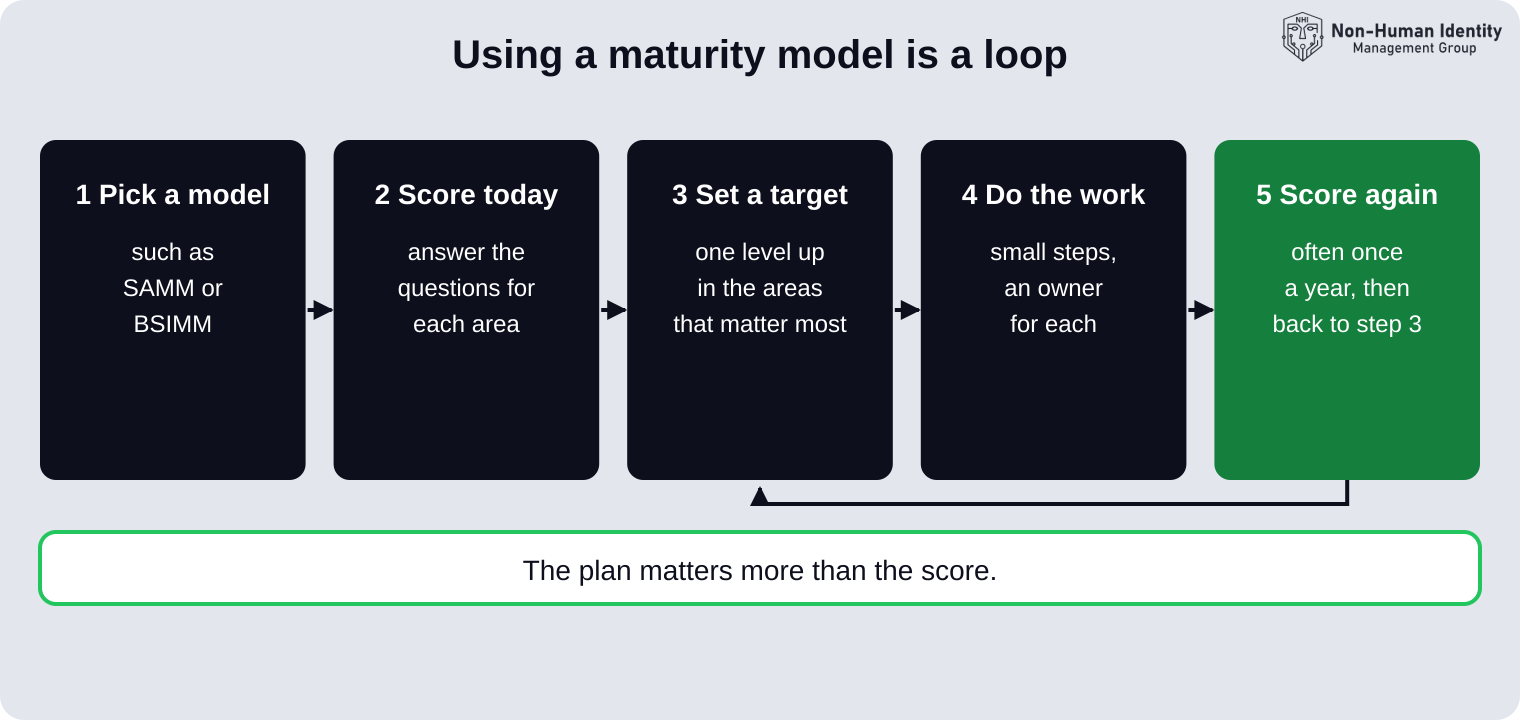
Most teams use a maturity model in a simple loop that they repeat over time.
- Pick a model. SAMM splits the work into five business functions: governance, design, implementation, verification and operations. Each has three practices, so there are fifteen in all.[1]
- Score today. Answer the questions for each practice. SAMM gives each practice three maturity levels, each with harder goals than the last.[2]
- Set a target. Choose the areas that matter most to your risks. SAMM's authors say there is no single recipe that suits every organisation.[2]
- Do the work. Take a few small steps in each chosen area, and give each step a named owner who will see it through.
- Score again. Repeat the health check, often once a year, and compare the new scores with the old ones.
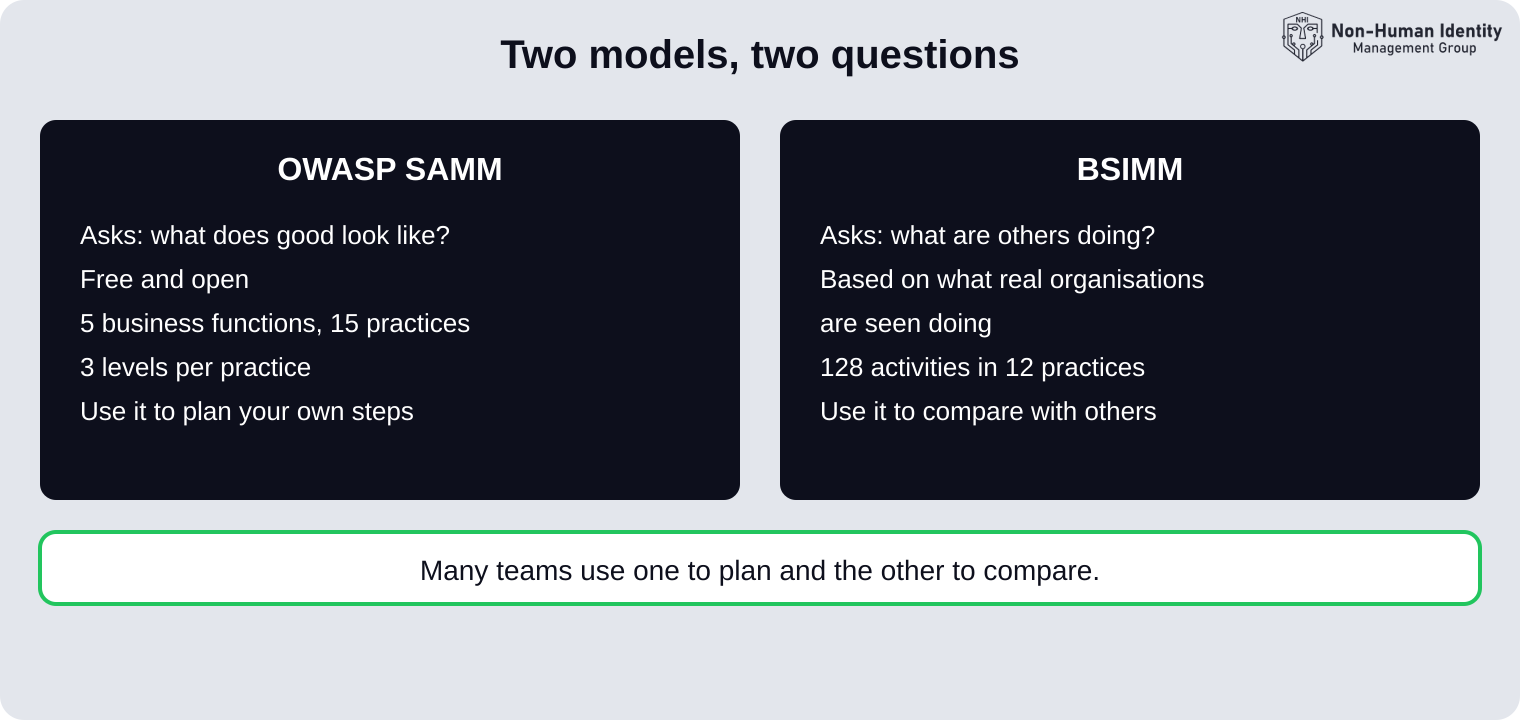
BSIMM works differently. Its team studies what real organisations do, then publishes the results. The latest edition, BSIMM16, came out in January 2026. It is based on 111 organisations and lists 128 activities, grouped into four domains and twelve practices.[3] BSIMM's publisher calls it a descriptive model. It shows what others do, while SAMM sets out what you should aim for.[3]
A worked example
Talia Abara runs product at Slate Accountants, a fictional firm that builds its own online tax tool. A large client asks how Slate keeps its software safe. Talia does not have a clear answer.
She asks Hal Rinaldi, the lead developer, to run a short health check using OWASP SAMM. They use the free questions and spend two afternoons with three developers.
The result surprises them. Their build process scores well, because Hal set it up with care. But nobody has had security training in two years. The team also never stops to think how the tool could be attacked before building a new feature. That habit is called threat modelling.
Talia remembers the swimming badges. Nobody jumps from the first badge to the last. So they pick three areas and aim one level higher in each over the next year.
Hal books a short course for the team. They add a fifteen-minute threat modelling chat to the start of each large feature. They also agree how fast a security problem must be fixed once found.
Talia writes a one-page summary for the client. It shows the scores, the targets and the date of the next check. The client is happier with an honest plan than with a vague promise.
A year later the scores have moved up in two of the three areas. The third needs more time, and that goes into the next plan.
Myths and mistakes
| What people think | What is true |
|---|---|
| We should aim for the top level everywhere. | Most teams pick the areas that matter most and raise them one step at a time. |
| A maturity model is a certificate. | SAMM and BSIMM are measuring tools, not pass or fail certificates. |
| SAMM and BSIMM are rivals, so we must choose one. | They answer different questions. Many teams plan with one and compare with the other. |
| Buying more tools raises our score. | Tools help in some areas. Training, design and fixing problems on time count too. |
| Once we have scored, we are done. | Scores can slip when people and tools change. Score again on a set date. |
What can I do this week?
- Read the list of SAMM business functions and practices on the official site.
- Ask your team which areas they think are strongest and weakest.
- Book a short health check with two or three people who build the software.
- Ask your main software suppliers whether they measure themselves against a public model.
Checklist
- We have chosen one maturity model to measure ourselves against.
- We have scored every area at least once, with the people who do the work.
- Each target is one level up, in an area that matters to our risks.
- Each target has a named owner and a few clear actions.
- We have a date to score again.
- Results are shared with managers in plain words.
Common questions
Is OWASP SAMM free?
Yes. SAMM is an OWASP project published under an open licence, so anyone can read and use it. The model, its questions and its guidance are on the official SAMM website. Some firms sell help with running a health check, but you can start on your own.
What is the difference between SAMM and BSIMM?
SAMM tells you what good practice looks like and helps you plan your next steps. BSIMM tells you what a group of real organisations are seen doing, so you can compare yourself with them. Many teams use SAMM to plan and BSIMM data to compare.
How long does a first health check take?
A small team can often finish a light first check in a few working sessions, though bigger teams take longer. Keep it honest and simple. The aim is a fair starting point and a short plan, not a perfect score.
Do small companies need a maturity model?
Not always, but a light version helps. Even a five-person team can score a few areas, pick two targets and check again next year. It also gives you a clear answer when a large customer asks how you build software safely.
Who should take part in the health check?
The people who do the work, plus someone who can approve changes. Developers, testers and the person who runs the build process know what really happens. A manager makes sure the plan gets time and money.
Where next?
Ready for the detail? Read the practitioner guide: AppSec Maturity Model. It goes further into scoring each area level by level, comparing SAMM, BSIMM and DevSecOps models, and the measures that show a programme is improving.
Also useful:
- OWASP SAMM Guide
- BSIMM
- Application Security for Beginners
- Threat Modelling for Beginners
- Security Champions for Beginners
Related NHI Mgmt Group resources: Application Security Guide · NIST SSDF for Beginners · Secure Code Review for Beginners
Key terms
- Maturity model
- A framework that judges how developed a capability is against a set of stages.
- OWASP SAMM
- A free, open maturity model that describes good software security practice and how to improve it.
- BSIMM
- A model built from what real organisations are seen doing, used to compare software security work.
- Practice
- One area of building safe software, such as training, testing or fixing problems.
- Assessment
- Answering a model's questions to find the level a team is at today.
- Threat modelling
- A structured way to think about how a system could be attacked before it is built or changed.
Sources and further reading
- The Model. OWASP SAMM (Software Assurance Maturity Model) version 2.0, OWASP Foundation. https://owaspsamm.org/model/, accessed 28 Nov 2026.
- About SAMM. OWASP SAMM, OWASP Foundation. https://owaspsamm.org/about/, accessed 28 Nov 2026.
- BSIMM: Building Security In Maturity Model (BSIMM16). Black Duck, January 2026. https://www.blackduck.com/resources/analyst-reports/bsimm.html, accessed 28 Nov 2026.