The UK Software Security Code of Practice is a voluntary set of security promises for firms that sell software.
This guide is for people who run or work in small software firms, managers and buyers of business software. You do not need to be technical: the Code is written mainly for senior leaders, and buyers can use it when choosing suppliers.
In short
- The UK government published the Code in May 2025, with help from the National Cyber Security Centre.
- It has fourteen principles in four themes: design, build, ship and fix, and talking to customers.
- It is voluntary, but customers can ask for it in contracts and supplier questions.
- One senior leader should be accountable, and a free self-assessment form helps show progress.
What you will learn
- Explain what the Code is and who it is for.
- Name its four themes in plain words.
- Check whether the Code is likely to matter to your firm.
- Ask a software supplier the right questions about it.
Status: correct as at 28 November 2026, based on the Code's page on GOV.UK (last updated 15 January 2026). Codes and schemes change; check the official text.
This guide explains the topic in general terms and is not legal advice.
- Software seller (software vendor)
- a firm that makes and sells software or software services.
- Senior owner (Senior Responsible Owner)
- the senior leader who is accountable for the firm following the Code.
- Bug report route (vulnerability disclosure process)
- a published way for outsiders to report security flaws to a firm.
What is the UK Software Security Code of Practice?
Think of a food hygiene checklist that a kitchen agrees to follow. Diners cannot see inside the kitchen, but they can ask to see the checklist and how the kitchen scores.
The Code works the same way for software. Customers cannot see how software is built. The Code gives them a shared list of good habits. A software vendor (a firm that makes and sells software) can sign up to it and show evidence.
It asks firms to build software with care and to protect the place where it is made. They should also fix flaws in good time and be honest with customers. That includes saying how long a product will get updates.
It is a code of practice, not a law. No one is fined for ignoring it. But it can become a firm promise when a customer writes it into a contract.
Where the comparison stops working: a food hygiene rating is checked by an inspector. For now, firms mostly assess themselves against the Code.
Why does it matter?
Many businesses depend on software they did not write. When that software has a flaw, every customer can be hit at once. The Code aims to make those flaws less likely and to make communication with customers clearer.[1]
If you run a small software firm
What could happen: a large customer asks if you follow the Code, and you have no answer ready.
Check this: name a senior owner and fill in the free self-assessment form.
If you buy software for your organisation
What could happen: a product you rely on stops getting updates with little warning.
Check this: ask suppliers how long they will support the product and how they report flaws.
If you are a developer
What could happen: your build system is left open, and someone slips harmful code into an update.
Check this: ask who can sign in to the build system, and whether they use a second sign-in step.
What does it look like?
Here is a made-up "Am I affected?" card that a small firm might fill in on its first look at the Code.
Example only. All values are made up.
EXAMPLE Software Ltd  -  Am I affected?  (FAKE)
We build and sell software to businesses:  YES   (1)
We only resell other firms' software:      NO    (2)
Customers have asked about the Code:       YES   (3)
Senior owner named:                        NOT YET (4)
Published support period for products:     NOT YET (5)
Self-assessment last done:                 0000-00-00
- Firms that build and sell software are the main audience, so all fourteen principles apply.
- Firms that only resell are asked to follow the last two themes.
- This line shows whether buyers are already asking.
- One senior leader should be accountable for the Code.
- The Code asks firms to say how long they support each product.
Why this is risky: the firm has no named owner and no stated support period. Those are two of the first things a buyer is likely to ask about.
The safer way: name the senior owner first. Then work through the self-assessment form one theme at a time, and publish the support period for each product.
How does it work?
The Code groups its fourteen principles into four themes.[1]
- Design. Follow a recognised way of building software safely. Know what parts your software is made of, test it before release and make it safe by default.
- Build. Protect the systems where software is put together from people who should not get in. Control and record changes to them.
- Ship and fix. Deliver software safely and publish a way for people to report flaws. Fix problems and send updates in good time.
- Tell customers. Say how long you will support a product, give at least a year's notice before support ends and share news of serious incidents.
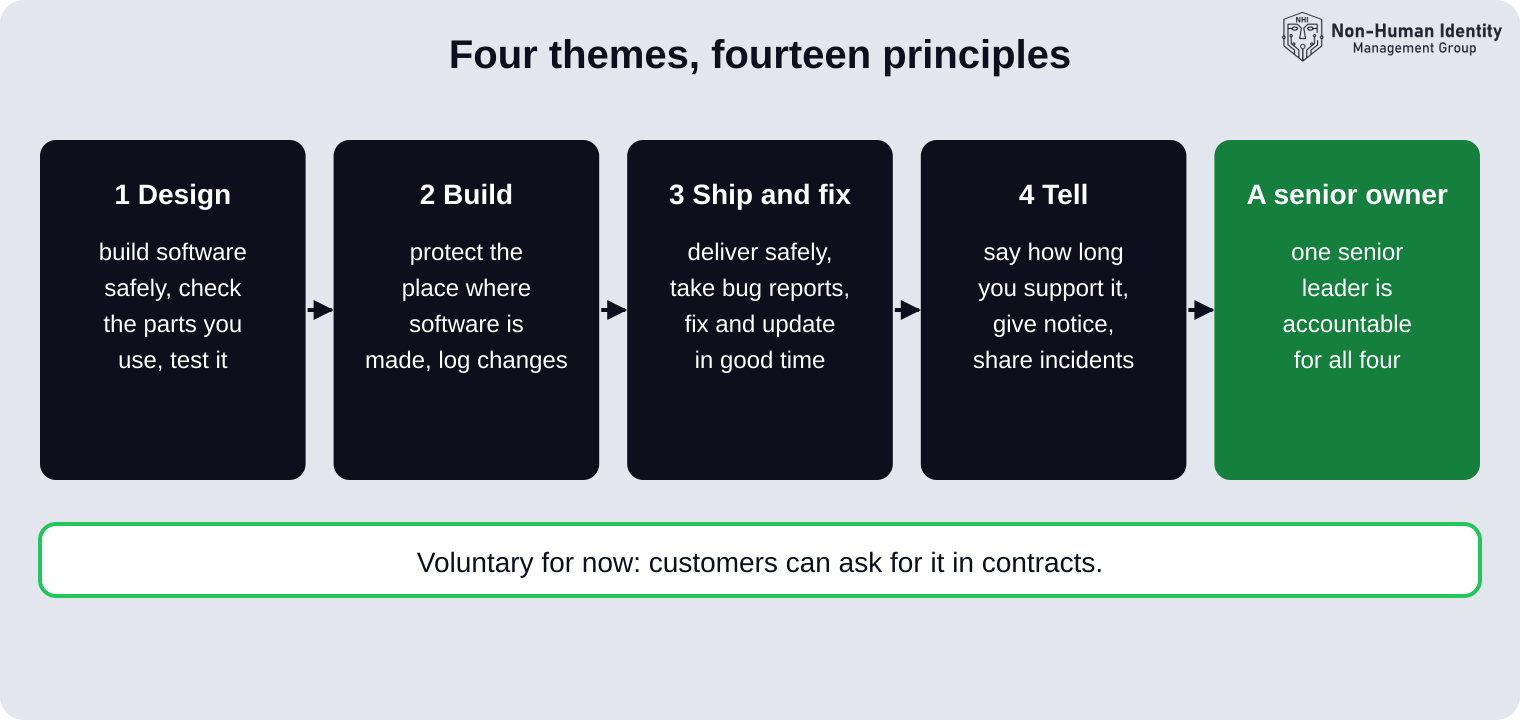
Not every firm needs every theme. Firms that only resell software are asked to follow themes three and four. Teams that build software but do not sell it, such as in-house teams, follow themes one and two, and parts of three.[1]
The government offers a self-assessment form. A firm can use it to track its own progress or share it with customers.[1] The National Cyber Security Centre also publishes guidance with suggested claims for each principle. These describe outcomes, so each firm can choose measures that suit its software.[3]
The Code says a certification scheme is being developed.[1] In January 2026 the government added details of a Software Security Ambassadors Scheme, where named firms champion the Code.[2]
A worked example
Yusuf Varga runs a fictional ten-person firm that sells booking software to small businesses. One of his biggest customers, Cobble Removals, is renewing its contract.
The new contract has a question: "Do you follow the UK Software Security Code of Practice?" Yusuf has heard of it but never read it.
He thinks of a food hygiene checklist. Cobble Removals cannot see inside his kitchen, so they want to see his checklist.
First, Yusuf names himself as the senior owner. He then asks his lead developer, Jana Tanaka, to go through the free self-assessment form with him. It takes a few sessions.
The results are mixed. The team already tests each release and keeps the build system locked down with a second sign-in step. But there is no published way for outsiders to report flaws. The firm has also never told customers how long each version will get updates.
Jana sets up a simple page explaining how to report a security flaw. Yusuf writes a support statement for each product, with at least a year's notice before support ends.
They send Cobble Removals the completed form. It shows what is in place, what has just changed and two items planned for the next six months.
The customer signs. Yusuf adds a yearly reminder to update the form, because he expects other buyers to start asking the same question.
Myths and mistakes
| What people think | What is true |
|---|---|
| The Code is a new law. | It is voluntary. It becomes binding only if a contract or agreement says so. |
| Only big tech firms need to care. | Buyers of all sizes can ask suppliers about it, so small firms may be asked too. |
| The senior owner must be a security expert. | Deep technical skill is not required. The owner makes sure teams have the time, tools and skills.[1] |
| There is a certificate we can buy now. | The Code says a certification scheme is still being developed.[1] |
| Following the Code stops every attack. | The guidance says the principles target common attacks, not highly skilled and determined attackers.[3] |
What can I do this week?
- Read the Code's short summary page on GOV.UK.
- Decide which themes apply to your firm: build and sell, resell only or build only.
- Name a senior owner for the Code.
- Download the self-assessment form and fill in one theme.
- If you buy software, add two questions to your supplier checklist: support period and flaw reporting.
Checklist
- We know which of the four themes apply to us.
- A senior leader is named as accountable for the Code.
- We have filled in the self-assessment form at least once.
- We publish a clear way for people to report security flaws.
- Access to our build systems is limited and protected with a second sign-in step.
- Each product has a stated support period.
- We give customers at least a year's notice before support ends.
- We have a plan for telling customers about serious incidents.
Common questions
Is the UK Software Security Code of Practice mandatory?
No. The Code is voluntary, and no one is fined for not following it. It can still matter, because customers can write it into contracts or ask about it when choosing suppliers. Once a contract says you follow it, that promise is binding under the contract.
Who is the Code for?
It is mainly for firms that build and sell software to other businesses, including software sold as an online service. Resellers and in-house teams are asked to follow some themes. Buyers can use it in supplier talks. Open source maintainers are not its main audience.
Is there a certificate for the Code?
Not yet. As of November 2026, the Code says a certification scheme is being developed. For now, firms can use the free self-assessment form to record their progress and share it with customers who ask.
How is it different from Cyber Essentials?
They cover different things. Cyber Essentials is about protecting an organisation's own computers and networks. The Software Security Code of Practice is about how a firm builds, ships and supports the software it sells to others. A software firm might follow both.
What does a small firm need to do first?
Name a senior owner and read the Code's short list of principles. Then work through the self-assessment form one theme at a time. Start with gaps a customer will notice, such as a flaw reporting page and a stated support period.
Where next?
Ready for the detail? Read the practitioner guide: UK Software Security Code of Practice. It goes further into each of the fourteen principles, the evidence the guidance expects and how the Code links to other frameworks.
Also useful:
- Secure by Design for Beginners
- NIST SSDF for Beginners
- EU Cyber Resilience Act for Beginners
- Cyber Essentials for Beginners
- Software Supply Chain Security for Beginners
Related NHI Mgmt Group resources: UK Cyber Governance Code of Practice Guide · Software Liability and Secure by Design Policy Guide · Software Security Maturity Models for Beginners
Key terms
- Software vendor
- A firm that makes and sells software or software services.
- Senior Responsible Owner
- The senior leader accountable for a firm following the Code.
- Secure by design
- Building security into software from the start, not adding it at the end.
- Build pipeline
- The systems and steps that turn code into a finished product ready to ship.
- Vulnerability disclosure policy
- A published statement telling people how to report security flaws to a firm.
- End of life
- The point when a product stops getting updates and support.
Sources and further reading
- Software Security Code of Practice. GOV.UK, UK government, published 7 May 2025, updated 15 January 2026. https://www.gov.uk/government/publications/software-security-code-of-practice/software-security-code-of-practice, accessed 28 Nov 2026.
- Software Security Code of Practice (publication page and change history). GOV.UK, UK government. https://www.gov.uk/government/publications/software-security-code-of-practice, accessed 28 Nov 2026.
- Software Security Code of Practice: implementation guidance, About. National Cyber Security Centre. https://www.ncsc.gov.uk/collection/software-security-code-of-practice-implementation-guidance/about, accessed 28 Nov 2026.