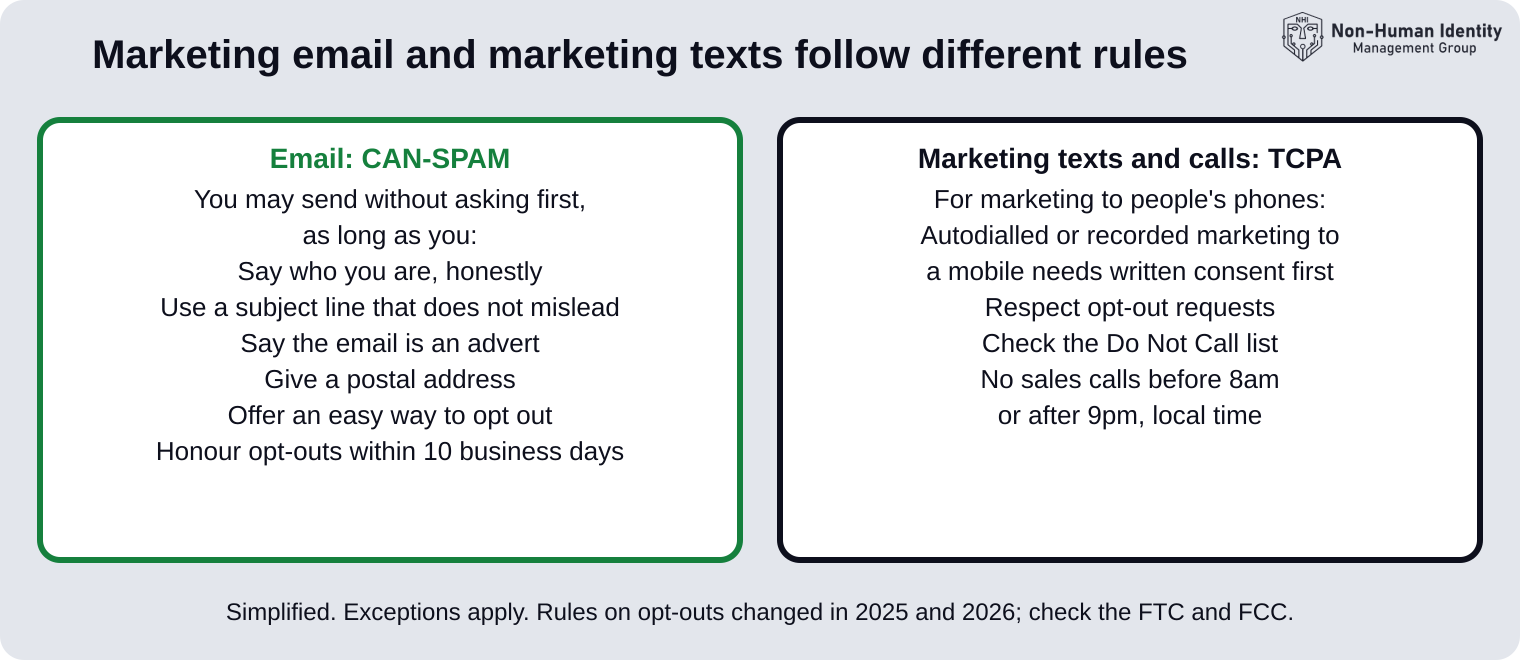
Two US federal laws set the main rules for marketing emails, texts and calls: CAN-SPAM and the TCPA.
This guide is for anyone who sends, or plans to send, marketing messages to people in the United States. You do not need a legal background. If your business has a mailing list or sends offers by text, these rules may apply to you.
In short
- CAN-SPAM covers marketing email. You may send without asking first, but you must be honest, give a postal address and offer an easy opt-out.[1]
- Opt-out requests for email must be honoured within 10 business days.[1]
- The TCPA covers calls and texts. Autodialled or recorded marketing to a mobile needs the person's written consent first.[3]
- Breaking the TCPA can lead to lawsuits from the people who got the messages, with at least $500 in damages for each one.[2]
What you will learn
- Explain the difference between the email rules and the text and call rules.
- Spot what every marketing email must include.
- Check that you have consent before sending marketing texts.
- Ask the right questions of a marketing agency or email platform.
Status: correct as at 28 November 2026, based on the Federal Trade Commission (FTC), the Federal Communications Commission (FCC) and the published law. The FCC adopted changes to parts of its opt-out rules in October 2026. Laws change; check the official text.
This guide explains the topic in general terms and is not legal advice.
- Marketing email law (CAN-SPAM)
- the US law on commercial email, enforced mainly by the FTC.
- Calls and texts law (TCPA)
- the Telephone Consumer Protection Act, the US law on marketing calls, texts and recorded messages.
- Opt-out
- a way for someone to say "stop sending me these".
What are the US email and text marketing rules?
Think of two kinds of front door. One has a "no junk mail" sign, and the other has a sign that says "invited guests only". At the first door you may drop a leaflet until the owner puts up the sign. At the second, you need an invitation before you knock.
US marketing email works like the first door. Under CAN-SPAM, a business can send marketing email without asking first. It must stop when the person opts out.[1]
Automated marketing texts and calls to mobiles work more like the second door. Under the TCPA, the business usually needs the person's written consent before it sends.[3]
Where the comparison stops working: a door sign is easy to see. A person's opt-out or consent sits in a business's records, so the records have to be kept carefully.
Why does it matter?
Each email that breaks CAN-SPAM can bring a penalty of up to $53,088, according to the FTC.[1]
If you run a small business
What could happen: you hire an agency to send emails, and it breaks the rules in your name.
Check this: hiring someone else does not move the legal duty off you. Check what they send.
Next: Email Deliverability and Bulk Sender Rules for Beginners
If you work in marketing
What could happen: a text campaign goes to numbers bought from a list, with no consent on record.
Check this: only text people who signed up with you, and keep proof of how they did.
If you are a customer
What could happen: you keep getting sales calls you never asked for.
Check this: add your number to the free National Do Not Call Registry, and report calls that continue.
What does it look like?
Here is a made-up marketing email with the parts that CAN-SPAM asks for.
Example only. All values are made up.
From: Example Bakery <[email protected]>            (1)
Subject: 20% off pies this weekend                (2)
-----------------------------------------------
Advertisement                                     (3)
Our autumn pies are back. Order online by Sunday.
-----------------------------------------------
Example Bakery, 0 Example Street, Example City    (4)
Do not want these emails? Unsubscribe here.       (5)
- The sender's name and address are honest and show who the email is from.
- The subject line matches what is inside.
- The email says clearly that it is an advert.
- In a real email, this line would contain a valid postal address. A registered post office box can count.
- A clear opt-out link. It must keep working for at least 30 days after sending.
Why this is risky: leave out any of these parts, and every email sent could break the law.
The safer way: build these parts into your email template, so every message has them by default.[1]
How does it work?
- Decide what kind of message it is. If its main purpose is to sell, it is commercial, and CAN-SPAM applies in full. Messages about an order or account, such as a receipt, are transactional. These must still have honest sender details.[1]
- For email, follow the CAN-SPAM rules. Be honest about who you are and what is inside. Say it is an advert, give a postal address and offer an opt-out. The law also covers email sent to other businesses.[1]
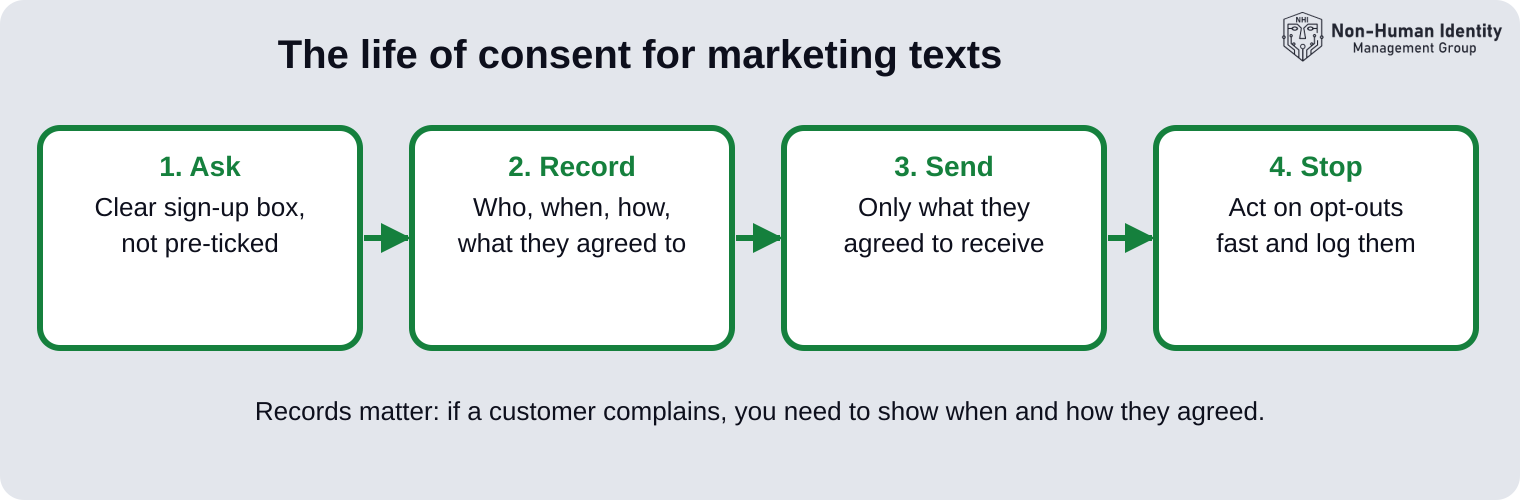
- For automated marketing texts or calls to mobiles, get written consent first. This covers messages sent with an autodialler (software that dials numbers) or a recorded or artificial voice.[3]
- Check the Do Not Call list before sales calls. Do not make sales calls to homes before 8am or after 9pm, local time.[3]
- Stop when people ask. Email opt-outs must be honoured within 10 business days.[1] For texts, a reply such as "STOP" is a common way to opt out. Under FCC changes adopted in October 2026, a business may name one clear way to opt out, if it says so plainly.[5]
A worked example
Freya Osei runs a made-up plant shop in Ohio called Fernhill Plants. She wants to start a weekly email and a text alert for flash sales.
For the email, she sets up a template with her shop name, an "Advertisement" label and the shop's postal address. Her email platform adds an unsubscribe link to every message. She checks the opt-out list each week, so nobody who opted out gets the next email.[1]
Texts are different. A friend suggests she text every customer whose number is on an old order form. Freya checks first. Her text tool sends messages in bulk, so she treats the texts as automated marketing to mobiles, which needs written consent.[3]
So she adds a separate sign-up box at checkout. It is not ticked in advance. It says what customers will get and how often. Her text tool records the date, time and wording each person agreed to.
A month later, a customer replies "STOP" to a sale alert. The tool removes the number and sends one short message that confirms the opt-out, with no sales content. The FCC rules allow one confirmation text like this.[3]
Freya also asks her text provider how it handles opt-outs. She plans to check again when the FCC's newest rule changes take effect.
Myths and mistakes
| What people think | What is true |
|---|---|
| US law says you need consent before sending marketing email. | CAN-SPAM is mainly an opt-out law. You must be honest and stop when asked.[1] Other laws or platform rules may ask for more. |
| Business-to-business emails are exempt. | CAN-SPAM makes no exception for email to businesses.[1] |
| Texts follow the same rules as email. | Automated marketing texts to mobiles usually need written consent first.[3] |
| If an agency sends it, the agency is responsible. | The FTC says hiring another firm does not move the legal duty off you.[1] |
| The Do Not Call list stops all unwanted calls. | It covers sales calls from firms that follow the law. Scammers ignore it, and some calls, such as surveys, are still allowed.[4] |
What can I do this week?
- Open your last marketing email and check it has your name, an honest subject, a postal address and an opt-out link.
- Test your unsubscribe link and see how long the removal takes.
- Find where text consent is recorded, and check you could show it for any number.
- Ask your agency or platform how they handle opt-outs and Do Not Call checks.
- If you get unwanted sales calls, add your number to the National Do Not Call Registry.
Checklist
- Every marketing email shows who it is from, honestly.
- Subject lines match the content.
- Marketing emails say they are adverts and give a postal address.
- Every marketing email has a working opt-out.
- Email opt-outs are acted on within 10 business days.
- We have written consent before sending automated marketing texts.
- We keep records of when and how each person agreed.
- Our call lists are checked against the Do Not Call Registry.
Common questions
Do password reset or order emails count as marketing?
Usually not. Emails about an order or an account are transactional, and most CAN-SPAM rules do not apply. They must still have honest sender details. If such an email is mostly sales content, it may count as marketing.[1]
How do I stop sales calls to my phone?
Register your number on the National Do Not Call Registry. It is free and does not expire. Sales calls can take up to 31 days to stop. Some calls are still allowed, such as charities, surveys and political calls.[4]
Can a customer sue me over a marketing text?
Yes. The TCPA lets a person sue for each call or text that breaks it. The court can award their actual loss or $500 for each one, whichever is greater. A court can triple this if the breach was wilful or knowing.[2]
Does replying STOP to a text always work?
It is a common way to opt out, and many firms use it. Under FCC changes adopted in October 2026, a business may instead name one clear opt-out method, such as a website, if it says so plainly. Check the message for the method it gives.[5]
Is this the same as the UK rules?
No. In the UK, marketing emails to individuals usually need consent first. The US email law works mainly on opt-out. If you market in both places, follow both sets of rules. PECR and Email Marketing Rules for Beginners explains the UK side.
Where next?
Ready for the detail? Read the practitioner guide: CAN-SPAM and TCPA Guide. It goes further into header rules, consent records, the 2025 and 2026 rule changes and AI voices on calls.
Also useful:
- PECR and Email Marketing Rules for Beginners
- Business Text Messaging for Beginners
- Email Deliverability and Bulk Sender Rules for Beginners
- Spam Filters for Beginners
Related NHI Mgmt Group resources: Email Authentication for Beginners · Text Message Scams for Beginners · CCPA and CPRA for Beginners
Key terms
- CAN-SPAM
- The US law that sets rules for commercial email, such as honest headers and a working opt-out.
- Telephone Consumer Protection Act
- The US law on marketing calls, texts and recorded or artificial voice messages.
- Transactional email
- An email about an order or account, such as a receipt, rather than a sales message.
- Unsubscribe
- A link or reply that lets someone stop getting marketing messages.
- Consent revocation
- Taking back permission that was given earlier, such as opting out of texts.
- Robocall
- A call made by an automatic dialler or that plays a recorded or artificial voice.
- Spam
- Unwanted bulk messages, often marketing, sent by email or text.
Sources and further reading
- CAN-SPAM Act: A Compliance Guide for Business. Federal Trade Commission (FTC). https://www.ftc.gov/business-guidance/resources/can-spam-act-compliance-guide-business, accessed 28 Nov 2026.
- 47 U.S. Code 227, Restrictions on use of telephone equipment (Telephone Consumer Protection Act). Legal Information Institute, Cornell Law School. https://www.law.cornell.edu/uscode/text/47/227, accessed 28 Nov 2026.
- 47 CFR 64.1200, Delivery restrictions (FCC telemarketing and robocall rules). Legal Information Institute, Cornell Law School. https://www.law.cornell.edu/cfr/text/47/64.1200, accessed 28 Nov 2026.
- National Do Not Call Registry FAQs. FTC Consumer Advice. https://consumer.ftc.gov/articles/national-do-not-call-registry-faqs, accessed 28 Nov 2026.
- FCC Revises TCPA Consent Revocation Framework and Seeks Further Comment. Mintz (law firm summary of the FCC Report and Order of 1 October 2026), 16 November 2026. https://www.mintz.com/insights-center/viewpoints/2776/2026-11-16-fcc-revises-tcpa-consent-revocation-framework-and-seeks, accessed 28 Nov 2026.