Privacy jargon is the set of special words used in data protection law and privacy work.
This guide is for new starters, students and anyone who keeps hearing words like "controller" or "SAR" at work. You do not need a legal background: if your job touches customer or staff details, these words describe your everyday tasks.
In short
- Most privacy words fall into four groups: people and roles, reasons for using data, people's rights, and risks and problems.
- The controller decides why and how data is used. A processor handles it on the controller's behalf.
- A subject access request (SAR) is a person asking for a copy of their own data. In the UK, organisations usually have one month to respond.
- When a word sounds like everyday English, such as "consent", check its exact privacy meaning before you act on it.
What you will learn
- Explain twelve common privacy words in plain English.
- Sort a new privacy word into one of four groups.
- Spot a subject access request, even when nobody uses that name.
- Ask the right person when a privacy word decides what you should do.
Status: correct as at 28 November 2026, based on guidance from the UK Information Commissioner's Office (ICO). Laws change; check the official text.
This guide explains the topic in general terms and is not legal advice.
- Information about a person (personal data)
- any detail that relates to a living person who can be identified, directly or indirectly.
- Using data (processing)
- anything done with personal data, from collecting and storing it to sharing and deleting it.
- Privacy watchdog (regulator)
- the public body that checks organisations follow data protection law.
What is privacy jargon?
Think of a tenancy agreement. Words like "landlord", "tenant" and "deposit" look ordinary, but in the agreement each one has an exact meaning that decides who must do what.
Privacy jargon works the same way. Privacy laws, like the UK GDPR and the EU GDPR, use a small set of words with exact meanings. Personal data is the starting point. It means any detail about a living person who can be named or picked out. That could be a name, an account number or an online ID.[1]
The person the data is about is called the data subject. The one that decides why and how the data is used is the controller. A firm that handles the data for the controller is a processor.[2]
Where the comparison stops working: a tenancy agreement is one document you can read end to end. Privacy words come from laws, guidance and court cases. Their meaning can also differ a little between countries.
Why does it matter?
A privacy word often decides who must act, and by when. Miss the word, and you may miss a deadline.
Take a personal data breach. If it must be reported to the UK regulator, the report is due within 72 hours of the organisation finding out.[3]
If you work on a front desk or in customer service
What could happen: a customer asks for "everything you hold on me", and nobody realises it is a formal request with a time limit.
Check this: know who in your organisation handles requests for a copy of someone's data.
If you run a small business
What could happen: you sign a supplier contract without knowing whether you or they are the controller.
Check this: for each supplier that holds customer data, write down who decides how that data is used.
If you are studying privacy or starting a privacy job
What could happen: you learn the words by heart but mix up close pairs, like anonymised and pseudonymised.
Check this: for each word, say what it makes someone do, not just what it means.
What does it look like?
Here is a made-up email from an IT supplier to a small dental practice. It is the kind of message a new office manager might receive.
Example only. All values are made up.
From: [email protected]
Subject: Booking app update (EXAMPLE)
- We act as your processor for patient data          (1)
- Our lawful basis note is attached for review       (2)
- The new reminder feature needs a DPIA first        (3)
- Test copies use pseudonymised data, ref FAKE-0000  (4)
- Please send any SARs to us within 2 days           (5)
- The supplier handles patient data on the practice's behalf. The practice stays the controller.
- A lawful basis is the legal reason for using personal data, such as a contract or consent.
- A DPIA is a check for privacy risks before starting something new that could be high risk.
- Names are swapped for codes, but the data can still be linked back, so it is still personal data.
- SARs are requests from patients for a copy of their own data. The practice still owns the deadline.
Why this is risky: a new office manager who does not know these words may skip the DPIA. They may also think the supplier deals with every request.
The safer way: keep a one-page list of privacy words used in your organisation. Ask the supplier or your privacy lead to explain any word in one plain sentence.
How does it work?
You do not need every privacy word at once. Here is a simple way to handle a new one.
- Write it down. Note the word exactly as you saw or heard it.
- Find the person. Ask who it is about: the data subject, the controller, the processor or the regulator.
- Sort it. Decide if it is a role, a reason for using data, a right, or a risk or problem.
- Check the action. Ask what the word makes someone do, and whether there is a deadline.
- Check locally. Ask your privacy lead how your organisation uses the word.
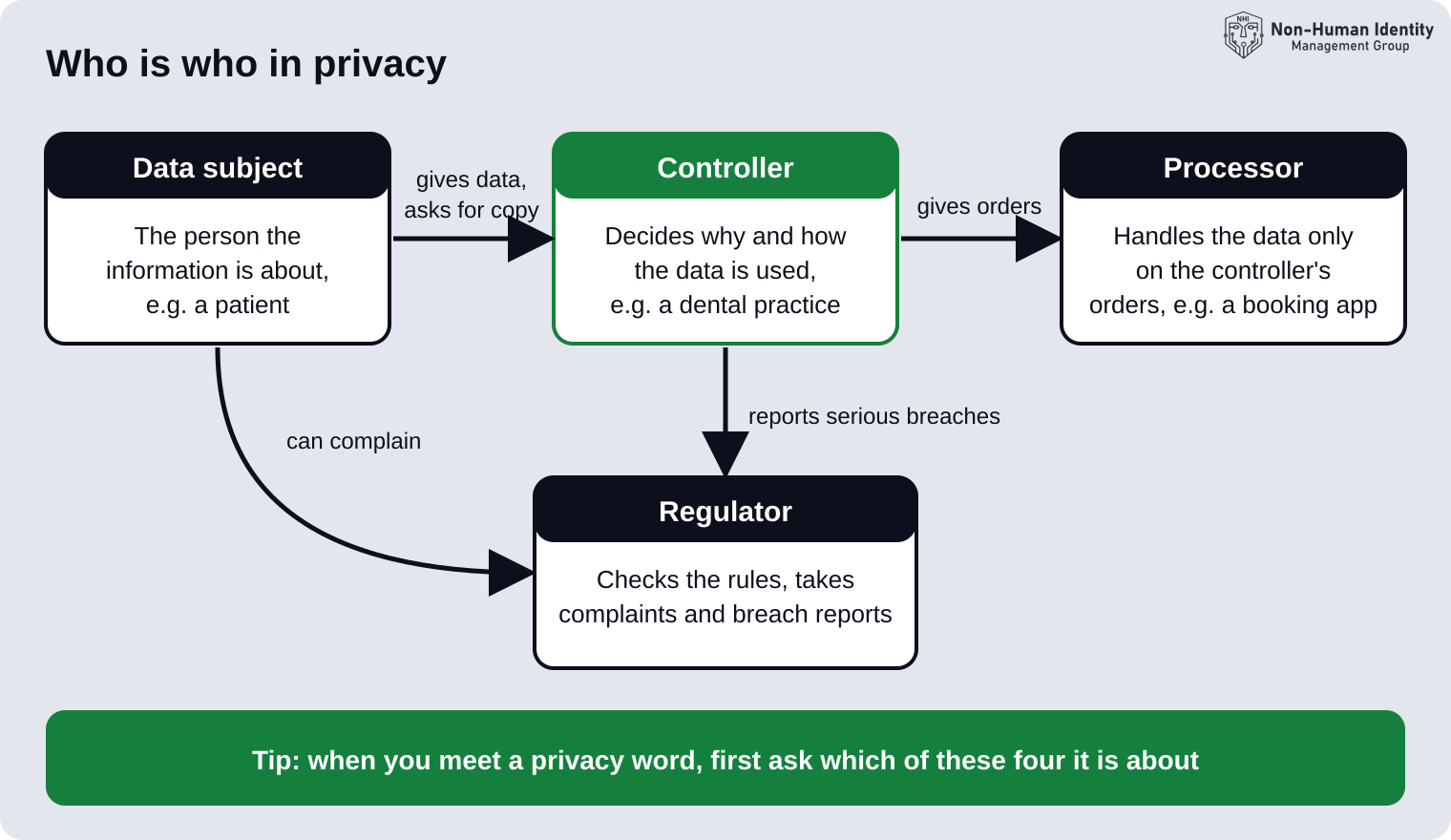
Here are twelve words you are likely to meet early, in four groups.
People and roles
- Data subject: the living person the data is about.[1]
- Controller: the organisation that decides why and how personal data is used.[2]
- Processor: a firm that handles personal data on the controller's behalf.[2]
- DPO: the data protection officer, a person who advises on and checks data protection inside an organisation.
Reasons for using data
- Lawful basis: the legal reason for using personal data. You need at least one, and consent is only one of the options.[4]
- Consent: a person freely agreeing to a specific use of their data.[4]
- Legitimate interests: a reason based on the organisation's own fair needs, which must be weighed against the person's interests.[4]
- Data minimisation: holding only the data you need for your purpose.[5]
People's rights
- SAR: a subject access request, when a person asks for a copy of their own data. It does not need to be in writing or use special words.[6]
Risks and problems
- DPIA: a data protection impact assessment, a structured check of privacy risks before high-risk work starts.[7]
- Personal data breach: a security problem that leads to personal data being lost, destroyed, changed or seen by the wrong people.[3]
- Pseudonymised: names swapped for codes, with the key kept apart. It is still personal data for anyone who holds that key.[8]
A worked example
Anil Quist starts as office manager at Quayside Dental, a fictional practice with six staff. On his second day, he opens the supplier email shown above.
It is from Ivo Falk, who looks after the practice's booking app. Anil counts five words he does not know. He remembers the tenancy agreement idea: ordinary-looking words can carry exact duties.
He makes a small table with three columns: the word, who it is about and what it makes someone do. He checks each word against the regulator's guidance.[2][6]
Two rows stand out. "Processor" tells him the practice, not Ivo's firm, is the controller. So the practice stays responsible for its patients' data. "Send any SARs to us within 2 days" tells him the supplier helps, but the practice must still reply to the patient on time.
That afternoon, a patient, Emil Jovanovic, rings and says, "Can you send me everything you've got about me?" He never says "subject access request". Anil now spots it. He logs the date and passes it to the practice owner, who answers within the time limit.
Last, Anil asks Ivo about the DPIA for the new reminder feature. Ivo sends a short template. The owner and Anil fill it in before the feature goes live.
By the end of the week, his word table has 15 rows. He adds it to the practice's staff handbook.
Myths and mistakes
| What people think | What is true |
|---|---|
| We always need consent to use customer data. | Consent is one lawful basis among several. A contract or legitimate interests may fit better.[4] |
| A SAR has to be a formal written letter. | A request can be spoken, written or sent on social media, with no special words.[6] |
| Pseudonymised data is anonymous. | If someone can link the codes back to people, it is still personal data.[8] |
| Our supplier holds the data, so it is their problem. | The controller usually stays responsible, even when a processor does the work.[2] |
| A breach only means hackers. | An email sent to the wrong person or a lost file can also be a personal data breach.[3] |
What can I do this week?
- Start a one-page list of privacy words used in your workplace, with a plain meaning for each.
- Find out who handles requests for a copy of someone's data, and how to pass one on.
- Ask which suppliers act as processors for your organisation.
- Learn who to tell, and how fast, if data goes to the wrong place.
Checklist
- I can explain personal data, data subject, controller and processor in plain words.
- I know at least three lawful bases, not just consent.
- I can spot a request for a copy of someone's data, even without the word SAR.
- I know who to tell about a possible personal data breach.
- I know when a DPIA is needed and who runs it.
- I can explain the difference between pseudonymised and anonymous data.
- My team has a shared list of privacy words with plain meanings.
Common questions
What is the difference between data privacy and data protection?
They are closely linked. Data privacy is about a person's control over their information. Data protection is the set of laws and practices that make organisations handle it properly. In everyday talk in the UK and EU, the two are often used as if they mean the same thing.
What does GDPR stand for?
GDPR stands for the General Data Protection Regulation. It is an EU law on how organisations use personal data. The UK has its own version, called the UK GDPR, alongside the Data Protection Act 2018. See GDPR for Beginners.
How long does an organisation have to answer a SAR?
In the UK, organisations usually have one month to respond. The regulator says this can sometimes be extended, so check its guidance for your case.[9] See Subject Access Requests for Beginners.
Is an anonymised file still covered by privacy law?
Usually not, if it is truly anonymous and nobody can link it back to a person. Pseudonymised data is different. It stays personal data for anyone who holds the key to link it back.[8] See Anonymisation and Pseudonymisation for Beginners.
Where can I look up a privacy word I do not know?
Start with your national regulator's guidance, such as the ICO in the UK. It explains the main terms in plain language. For a wider list of terms, see our Privacy and Data Protection Glossary, and ask your privacy lead how your organisation uses each one.
Where next?
Ready for the detail? Read the practitioner guide: Privacy and Data Protection Glossary. It goes further into a much longer A to Z list of terms, the exact legal wording behind them and links to the official sources.
Also useful:
- Personal Data for Beginners
- Lawful Basis for Processing for Beginners
- Data Protection Impact Assessments for Beginners
- Data Breach Notification for Beginners
- Cyber Security Jargon for Beginners
Related NHI Mgmt Group resources: Data Privacy for Beginners · Controller vs Processor Guide · Privacy & Data Protection Executive Briefing
Key terms
- Personal data
- Any information about a living person who can be identified, directly or indirectly.
- Data subject
- The living person that personal data is about.
- Data controller
- The organisation that decides why and how personal data is used.
- Data processor
- A firm that handles personal data on a controller's behalf and follows its instructions.
- Lawful basis
- The legal reason an organisation relies on to use personal data.
- Subject access request
- A request from a person for a copy of the personal data held about them.
- DPIA
- A structured check of privacy risks before starting work that is likely to be high risk.
- Pseudonymisation
- Swapping names and other identifiers for codes, with the key to link them back kept separately.
Sources and further reading
- What is personal data? Information Commissioner's Office (ICO). https://ico.org.uk/for-organisations/uk-gdpr-guidance-and-resources/personal-information-what-is-it/what-is-personal-data/what-is-personal-data/, accessed 28 Nov 2026.
- What are 'controllers' and 'processors'? Information Commissioner's Office (ICO). https://ico.org.uk/for-organisations/uk-gdpr-guidance-and-resources/controllers-and-processors/controllers-and-processors/what-are-controllers-and-processors/, accessed 28 Nov 2026.
- Personal data breaches: a guide. Information Commissioner's Office (ICO). https://ico.org.uk/for-organisations/report-a-breach/personal-data-breach/personal-data-breaches-a-guide/, accessed 28 Nov 2026.
- A guide to lawful basis. Information Commissioner's Office (ICO). https://ico.org.uk/for-organisations/uk-gdpr-guidance-and-resources/lawful-basis/a-guide-to-lawful-basis/, accessed 28 Nov 2026.
- A guide to the data protection principles. Information Commissioner's Office (ICO). https://ico.org.uk/for-organisations/uk-gdpr-guidance-and-resources/data-protection-principles/a-guide-to-the-data-protection-principles/, accessed 28 Nov 2026.
- How do we recognise a subject access request (SAR)? Information Commissioner's Office (ICO). https://ico.org.uk/for-organisations/uk-gdpr-guidance-and-resources/individual-rights/right-of-access/how-do-we-recognise-a-subject-access-request-sar/, accessed 28 Nov 2026.
- What is a DPIA? Information Commissioner's Office (ICO). https://ico.org.uk/for-organisations/uk-gdpr-guidance-and-resources/accountability-and-governance/data-protection-impact-assessments-dpias/what-is-a-dpia/, accessed 28 Nov 2026.
- Pseudonymisation. Information Commissioner's Office (ICO). https://ico.org.uk/for-organisations/uk-gdpr-guidance-and-resources/data-sharing/anonymisation/pseudonymisation/, accessed 28 Nov 2026.
- Getting copies of your information (SAR). Information Commissioner's Office (ICO). https://ico.org.uk/for-the-public/getting-copies-of-your-information-subject-access-request/, accessed 28 Nov 2026.